
Hydraulic Seal Storage and Shelf-Life Control: A B2B Inventory Guide Before Installation
Hydraulic seals are precision-engineered components, yet many of them spend far more time on a shelf than they ever do inside a cylinder. Between the supplier’s factory and the moment a technician presses a seal into a gland, a kit passes through receiving docks, warehouse racks, distribution vans, and repair benches. Every one of those steps is a chance for the material that makes a seal work to be quietly compromised. For B2B distributors, hydraulic repair shops, fleet maintenance warehouses, and procurement teams, hydraulic seal storage is not a housekeeping detail. It is a risk-management discipline that shapes warranty claims, rework rates, and the confidence your customers place in the parts you ship.
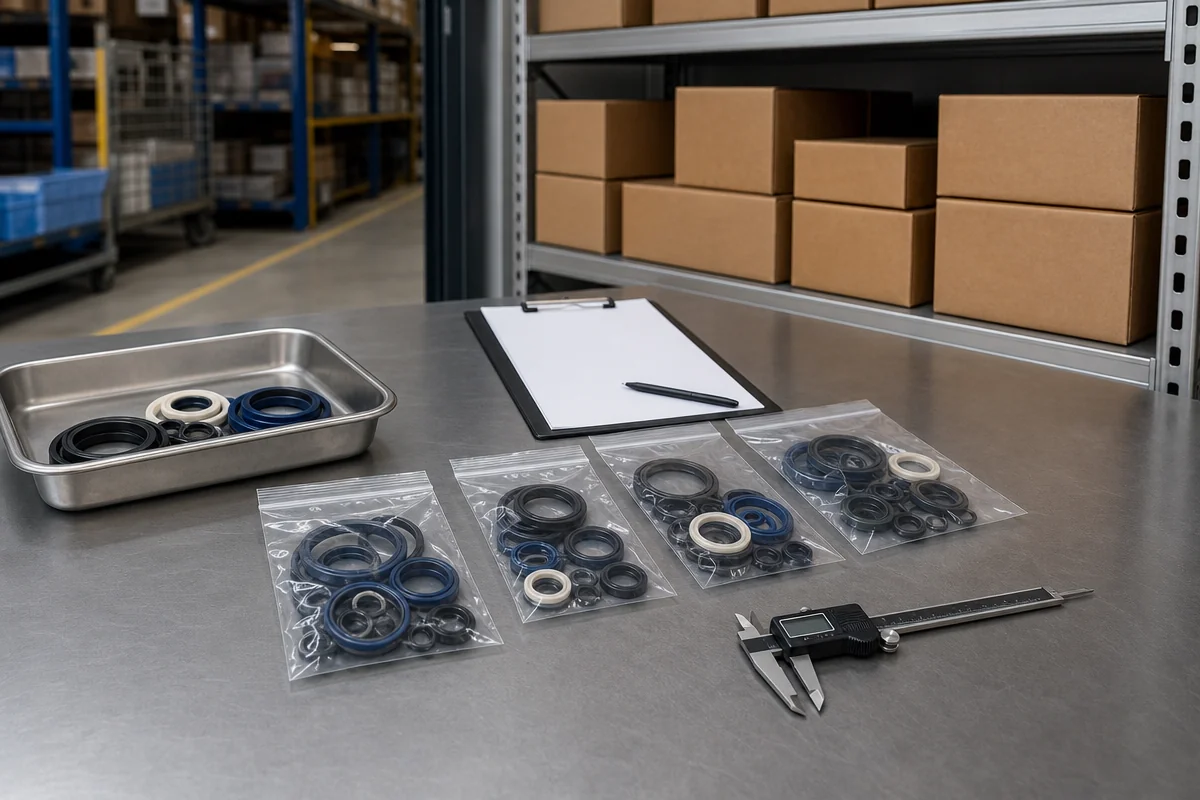
This guide is written for the people who own seal inventory before installation: warehouse managers who decide where boxes live, buyers who decide how much to hold, and quality teams who decide whether a kit is fit to ship. It focuses on practical control of hydraulic seal shelf life, the physical conditions that degrade elastomers, and the receiving, rotation, and quarantine routines that keep a hydraulic seal warehouse reliable. It does not promise a single magic number for shelf life, because no honest supplier can. What it does provide is a repeatable framework you can adapt to your own products, environment, and supplier data.
Why Storage Conditions Matter More Than Most Buyers Expect
A hydraulic seal is a system of materials: an elastomer or polymer body, often a fabric or metal energizer, and sometimes a bonded or inserted element. In service, that combination is asked to hold pressure, resist extrusion, follow a rod or bore, and survive temperature swings. In storage, the same material is exposed to a different set of enemies that act slowly and invisibly. A seal that leaves the factory within specification can arrive at the repair bench with a hardened surface, a distorted lip, a cracked back-up ring, or a surface contaminated by dust that will later score a rod.
Industry references reinforce this point. In mid-2026, a technical article on rods, fluids, and seals emphasized that the seal system cannot be treated in isolation: the relationship between seal materials, the operating fluid, the mating surface, and contamination control determines sealing performance. Storage is simply an extension of that relationship before operation begins. When a warehouse exposes seals to heat, sunlight, ozone from electrical equipment, or airborne dirt, it is effectively pre-loading a failure into a part that has done nothing wrong yet. Practitioners discussing early-warning checks on maintenance forums often point to leakage, temperature rise, contamination, and repeat seal failures as signals that upstream handling — including storage and installation — may be part of the problem rather than the part itself.
The economic argument is straightforward. Replacing a stored seal that has aged out costs a fraction of a remote service call, an unplanned machine outage, or a dissatisfied fleet customer. Treating seal storage conditions as an engineered process is cheaper than treating them as a lost-cost commodity.
The Physical Enemies of a Stored Hydraulic Seal
Most premature degradation in storage traces back to a small set of environmental and handling factors. Understanding each one lets you design controls instead of relying on luck.
- Light, especially ultraviolet: Direct sunlight and some artificial lighting accelerate oxidation of many elastomers, leading to surface hardening and cracking.
- Heat: Elevated temperatures increase the rate of chemical aging. A shelf near a roof, a radiator, or a loading-dock door in summer is a shelf that ages seals faster.
- Ozone: Ozone attacks unsaturated elastomers and is generated by electric motors, welders, and high-voltage equipment. Storage near such equipment shortens hydraulic seal shelf life.
- Humidity and moisture: Moisture promotes corrosion on metal components, energizers, and packaging hardware, and can support mold or hydrolysis in susceptible materials.
- Contamination: Dust, metal particles, machining debris, oils, and chemical vapors settle on sealing surfaces or migrate into packaging. Contamination that is invisible at receiving can become a rod-scoring defect later.
- Stress and deformation: Seals stored under compression, bent, hung, or stacked under heavy loads take a permanent set that prevents proper lip contact on installation.
- Packaging failure: Torn bags, crushed cartons, and broken seals on packaging remove the barrier that protects the part from all of the above.
The practical lesson is that seal storage conditions are cumulative. A part does not need one dramatic event to fail; it needs several mild exposures over many months. That is why a disciplined warehouse beats a lucky one.
Comparison Table: Storage Factors and Warehouse Controls
The table below maps the main degradation factors to the controls a hydraulic seal warehouse can realistically apply. It is a planning aid, not a substitute for your supplier’s specific guidance.
| Storage Factor | Effect on the Seal | Practical Warehouse Control |
|---|---|---|
| Light / UV | Surface hardening, cracking, color shift | Store in closed original packaging, away from windows and direct lamps |
| Heat | Accelerated aging, compression set | Keep racks away from roof skin, heaters, and dock doors; monitor peak temperature |
| Ozone | Cracking of unsaturated elastomers | Separate storage from motors, welders, and high-voltage equipment |
| Humidity / moisture | Corrosion of metal parts, hydrolysis in some materials | Control indoor humidity, avoid floor-level storage and condensation zones |
| Contamination | Scoring, poor sealing, fluid ingress | Dust-controlled racks, sealed packaging, clean-hands handling |
| Stress / deformation | Permanent set, distorted lips, kinked back-ups | Store flat or in supplied form, never bent or hung; limit stack height |
| Packaging failure | Loss of barrier against light, dust, moisture | Inspect bags and cartons at receiving and at pick; repack only with supplier-approved materials |
Packaging Is Part of Seal Storage Conditions
Original packaging exists for a reason. Good seal packaging reduces light transmission, limits oxygen and ozone contact, keeps dust out, and holds the part in a stress-free position. When a warehouse repacks seals into open bins for “easy picking,” it trades convenience for risk. Open bins expose parts to light, dust, and repeated handling, and they remove the batch label that links the part to its manufacturing data.
A workable policy is to keep seals in their original, sealed packaging until the moment of issue, and to store small kits in lidded, closed containers if the original carton is being broken down. If packaging must be replaced, use clean bags compatible with the seal material and re-label with the original batch and supplier information. Packaging decisions should be confirmed with the supplier, because material compatibility and the correct protective atmosphere vary by product.
Stress, Deformation, and “How Not to Stack”
Elastomers are not perfectly elastic over long periods. Under sustained compression or bending, they take a compression set — a permanent deformation that reduces the sealing force available at installation. A large-diameter O-ring folded into a tight loop, a lip seal stored standing on its lip, or a carton of rod seals squashed under heavy boxes will all show this effect.
Preventive rules are simple to state and easy to audit:
- Store flat, in the manufacturer’s supplied form, following any orientation printed on the packaging.
- Do not hang large seals by a single point; the weight creates a slow deformation.
- Limit stack heights so that lower cartons are not crushed.
- Separate heavy metal components from soft elastomer parts to avoid puncture and point loads.
- Respect any “this side up” or “do not crush” marking on the carton.
Hydraulic Seal Shelf Life: A Product-Specific Number, Not a Universal Promise
Purchasing teams often ask for a single shelf-life figure they can print on a label. The honest answer is that hydraulic seal shelf life depends on the specific material, the compound, the storage conditions actually achieved, and the supplier’s own testing and recommendations. Material suppliers publish general storage guidance — for example, elastomer storage principles that address light, heat, ozone, contamination, stress, and packaging — but those principles are a framework for control, not a guarantee that any given part remains fit for a fixed number of years.
This is where the “confirm with supplier” boundary matters. The shelf-life statement that should govern your warehouse is the one issued for the specific product you buy. That statement may specify a storage temperature range, a maximum humidity, a recommended rotation interval, and conditions under which the recommendation does not apply. Your job as a distributor or warehouse is to honor those conditions and to record them, not to invent a blanket number that applies to every seal in the building.
Two practical consequences follow. First, store shelf-life data at the part or product-family level, not as one global rule. Second, treat any stored seal that has exceeded the supplier’s recommended window as needing technical evaluation rather than automatic use or automatic scrap. The decision belongs to a documented review, ideally with supplier input.
Seal Kit Inventory Control: FIFO, Batch Rotation, and Aging Visibility
Seal kit inventory control is where storage policy becomes daily behavior. The goal is to ensure that the oldest acceptable stock is issued first, that every kit remains traceable to its batch, and that no kit silently ages past its recommended window at the back of a rack.
Core practices:
- First-in, first-out (FIFO): Issue the oldest qualifying stock first. Where supplier guidance or product risk requires it, use first-expiry, first-out (FEFO) so that date-limited items move first regardless of receipt order.
- Date marking at receipt: Apply a receipt date and, where the supplier provides one, a recommended use-by or rotation date. Do not rely on a manufacturer’s code alone if the code is not human-readable on the shelf.
- Batch segregation: Keep different batches of the same part visually separated so a pick cannot mix them. This supports the traceability chain that connects a shipped kit to its production data.
- Cycle counting: Count high-value and slow-moving seal lines on a defined cycle, not only at year end, to catch aging and mis-storage early.
- Location labeling: Every bin, shelf, and carton should carry the part number, batch, and receipt date so that any operator can apply FIFO without guessing.
Traceability and rotation are closely related. A warehouse that cannot state which batch it shipped cannot investigate a complaint, and a warehouse that cannot rotate cannot honor shelf-life windows. For a deeper treatment of the data side, see our guide on hydraulic seal kit traceability and batch control. For teams that source kits across borders, the logistics and receiving considerations are covered in our article on how to import hydraulic seal kits from China.
Receiving Inspection: The First Control Point
Aging in the warehouse cannot undo the condition in which stock arrives. Receiving is therefore the earliest and cheapest place to catch problems. A structured receiving check for seals should confirm:
- That the quantity and part numbers match the purchase order and packing list.
- That the batch or lot identification is present, legible, and recorded against the receipt.
- That packaging is intact — no torn bags, crushed cartons, or broken tamper seals.
- That there is no visible dust, oil, moisture, or odor indicating contamination or exposure.
- That elastomer parts show no obvious hardening, cracking, discoloration, or deformation.
- That the time in transit and any temperature extremes are noted in the receiving record.
Anything that fails these checks should not go straight to the picking racks. It belongs in a controlled decision path, which is the subject of the next section. When a received kit shows an unusual condition, document it with photos and raise it with the supplier before the batch is commingled with existing stock.
Pre-Shipment Checks and Dispatch Discipline
What leaves the dock defines your reputation. Before dispatch, a final check protects both the customer and the seller:
- Confirm the picked batch is within its recommended storage or rotation window.
- Confirm packaging is intact and, where relevant, that seals are still in their original protective wrap.
- Confirm the kit content matches the customer’s part number and application, and that the correct documentation travels with it.
- Record the batch and date shipped so that a future return can be matched to the original stock.
- For long-distance or high-value shipments, confirm that the transport method will not expose the seals to heat or crushing.
These steps are inexpensive at dispatch and expensive to skip. A returned or rejected shipment due to an aged or damaged seal damages customer trust far more than the value of the part.
Return Quarantine and the Status Decision Matrix
Returns and questionable stock must be isolated. The default for anything uncertain is quarantine, not restock. Mixing a returned seal back into sellable inventory without evaluation is the fastest way to ship a defect you did not create.
The table below summarizes three practical statuses and how to act on each. It is a decision aid; the final call on fitness for use should follow your quality procedure and, where required, supplier confirmation.
| Condition Observed | Status | Action |
|---|---|---|
| Original sealed packaging, batch legible, within rotation window, no visible defects | Normal usable | Restock at the correct location and continue FIFO/FEFO rotation |
| Past the supplier’s recommended window, or packaging opened with no visible damage | Technical confirmation required | Hold out of sellable stock; evaluate against product/supplier criteria before any use |
| Visible hardening, cracks, deformation, contamination, or crushed/wet packaging | Quarantine | Isolate, label as non-conforming, document, and notify the supplier/quality owner |
| Customer return with unknown history or field exposure | Quarantine | Never auto-restock; inspect and decide through the documented return process |
Procurement and Warehouse Checklist
The following checklist condenses the guidance above into an auditable routine. It is written for warehouse managers, buyers, and quality staff who want a single page to work from.
- Environment: Store seals in a dry, dust-controlled area away from direct sunlight, heat sources, motors, welders, and high-voltage equipment.
- Temperature and humidity: Keep conditions within the range your supplier specifies for the product, and monitor for peaks rather than averages alone.
- Positioning: Store flat or in the supplied form; never bend, hang, or crush seals; respect carton orientation markings.
- Packaging: Keep original packaging intact until issue; repack only with supplier-approved materials and replace labels.
- Labeling: Record part number, batch, receipt date, and supplier-recommended rotation date on every carton and bin.
- Rotation: Apply FIFO and, where date-limited, FEFO; cycle-count slow movers on a defined schedule.
- Receiving: Verify quantity, batch, packaging integrity, and cleanliness before putting stock away.
- Dispatch: Confirm batch recency, packaging integrity, kit content, and documentation before shipping.
- Returns: Quarantine all returns and any uncertain stock until evaluated; never mix into sellable inventory.
- Records: Keep receiving, rotation, dispatch, and return records linked to batch numbers for traceability.
Working with Suppliers: Where Your Control Ends
A warehouse can control its own environment and its own handling, but it cannot invent shelf-life data or material-compatibility judgments. Those come from the manufacturer or supplier and should be documented per product. Ask your supplier for the storage conditions, the recommended rotation window, the packaging specification, and any material-specific cautions that apply. Confirm these in writing, and update your labels and procedures when the supplier’s guidance changes.
For a broader look at preventing failures in service — the leaks, temperature rises, and repeat failures that maintenance teams flag in early-warning checks — see our guide on hydraulic cylinder seal failure prevention. Storage control is the upstream half of that same story: a seal that is stored well arrives at the bench with its material properties intact, and that is the foundation of reliable sealing.
Conclusion
Hydraulic seal storage is a manageable risk. Light, heat, ozone, humidity, contamination, stress, and packaging failure are all predictable, and each has a practical control. Hydraulic seal shelf life is real but product-specific, so treat it as a supplier-confirmed parameter rather than a universal constant. Build your operation around strong seal storage conditions, disciplined seal kit inventory control with FIFO and batch rotation, a receiving check that catches problems early, a dispatch check that protects your reputation, and a quarantine default for anything uncertain. Do that, and your hydraulic seal warehouse becomes a source of reliability rather than a hidden source of failure.
 Excavator Center Joint (Swivel Joint) Seal Kits: Internal Cross-Port Leakage Troubleshooting, PTFE Step-Seal Selection & B2B Overhaul Guide
 Excavator Main Control Valve Seal Kits: Spool Leakage Troubleshooting, Material Selection & B2B Sourcing Guide
 Hydraulic Breaker Hammer Seal Kits: B2B Sourcing, Material Selection, and High-Frequency Shock Protection Guide
 Motor Grader Hydraulic Cylinder Seal Kits: A B2B RFQ and Selection Guide