
Hydraulic Seal Kit Traceability: A B2B Quality-Control Workflow Before Batch Orders
The moment every B2B buyer learns to respect comes at the receiving dock, when two pallets of hydraulic seal kits arrive and the boxes look identical: same supplier, same part number, same printed label. The only visible difference is a short batch code stamped on the carton, and the question that determines how much trouble the order will cause later is whether anyone records it. In recent discussions among hydraulic cylinder rebuilders, the same scene keeps surfacing from the other side of the bench: after disassembly, a technician finds that the seals in front of him do not match what the cylinder actually needs, the job goes back together with substitute components, the machine returns for rework, and the shop re-orders parts with only a vague memory of which kit was installed. At the same time, more replacement seal kits are now sold by OEM part number online, which makes the match look automatic — when in fact a part number alone proves nothing about the batch behind it. This guide is written for distributors, hydraulic repair shops, fleet maintenance teams, and procurement staff who buy seal kits in quantity. It lays out a practical hydraulic seal kit traceability workflow: the records to demand before a batch order, the checks to run when kits arrive, and the labeling and documentation discipline that turns a box of seals into an answerable business asset.
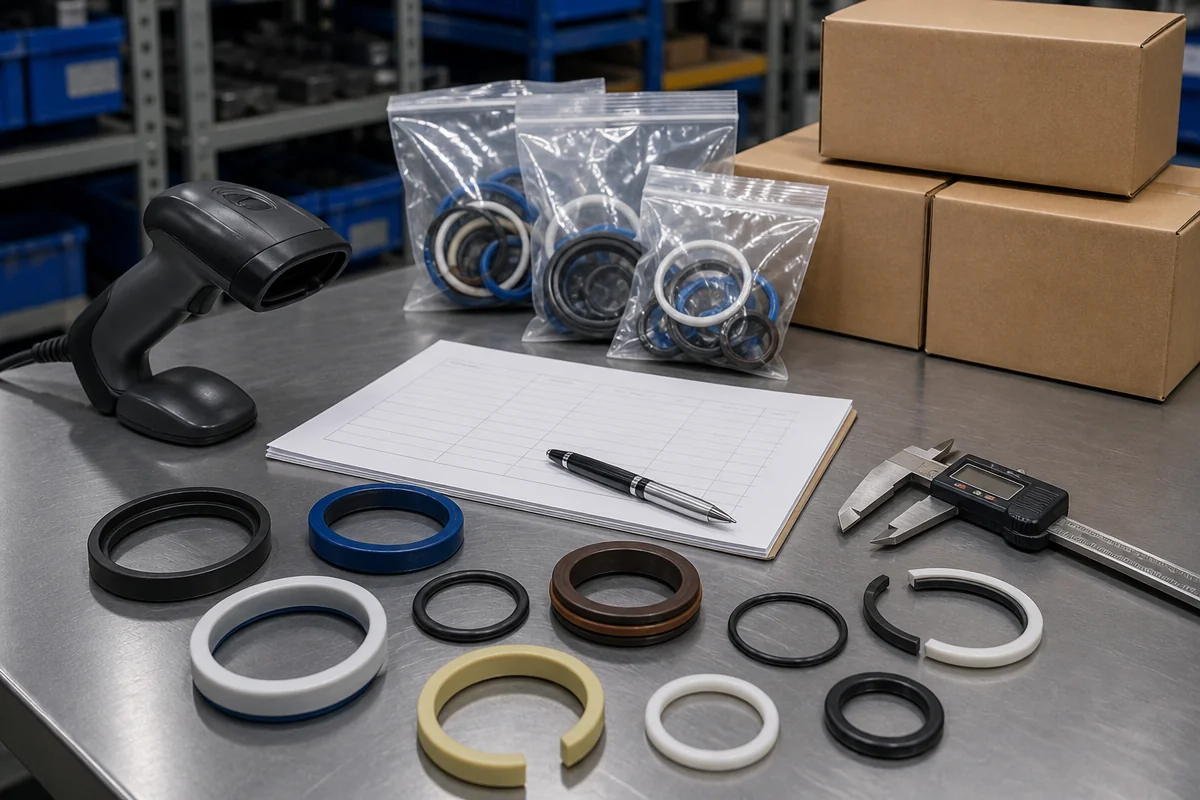
Why the right part number is not the same as a traceable kit
An OEM part number identifies what the original equipment manufacturer designed for a position in a cylinder. When a supplier lists a replacement kit under that number, the listing is a claim of equivalence, not proof of it. The kit still has to be manufactured from a specific compound, to specific geometry, in a specific production batch, and every one of those facts can vary between batches from the same supplier. A distributor who stocks three deliveries of the same kit across six months is physically holding three populations of product that share one label. Without records that tie each carton to its batch, no one can answer the questions that always arrive late: which delivery produced the kit that leaked, which cartons share the same compound lot, and which orders are affected if the supplier recalls a batch.
That is what hydraulic seal kit traceability means in operational terms: the ability to walk from a physical kit sitting on a shelf or inside a cylinder back to the batch it came from, the order it arrived on, the part number it was sold under, and the quality records that existed when it was made — and to walk forward again from a suspect batch to every carton and every customer order that touched it. For a repair shop, traceability answers a liability question before it becomes a legal one. For a distributor, it is the difference between recalling a single batch and recalling a whole product line. For fleet maintenance, it turns a warranty claim into a file that can be reviewed in an afternoon. For procurement, it is the mechanism that makes supplier performance measurable at all.
What a seal kit batch traceability system must capture
A workable system does not need to be complicated, but it needs three fixed reference points on every record: the supplier’s batch or lot number, your own order or PO number, and the part number of the kit. Those three identifiers are the keys that connect the physical product to the paperwork. Around them, the system captures what happened at each stage of the chain — specification, sample approval, production, shipment, receipt, and installation — so that any point in the chain can be reconstructed later. Batch-level control fails in one of two ways: either the identifiers are never recorded at the point of receipt, or they are recorded but the associated quality documents are not filed against them. Both failures look identical on a good day and cost the same amount on a bad one.
The table below compares what batch-level records change in the situations that actually occur after kits are ordered in quantity.
| Situation after a batch order | Without batch-level records | With batch-level records |
|---|---|---|
| A customer reports a leaking kit six months after installation | The shop guesses which order it came from; the supplier asks for a batch number nobody recorded; the claim stalls on both sides | The batch number on the box or work order pulls up the order, the certificate, and the approved sample reference in minutes |
| The supplier notifies you of a material or process deviation in one batch | Every carton in stock is suspect; stock is either scrapped blindly or released blindly | Affected batch numbers are checked against stock records and only those cartons are quarantined and inspected |
| Mixed stock of the same kit from several deliveries sits on the shelf | First-in-first-out is impossible to verify; old and new batches are indistinguishable | Each carton is labeled with its batch and receipt date; older batches issue first by label, not by memory |
| A rebuild is reworked and the same kit type must be ordered again | The order repeats the same part number with no reference to what was previously supplied or approved | The new order cites the previous order and sample approval, so any change since then must be declared |
A five-step traceability workflow before batch orders
The workflow below is written to run before the order is placed, because traceability cannot be added after the fact. The sequence assumes you are buying in batch quantities from an outside manufacturer or importer — what we describe here is the seal kit batch control process a buyer can implement on its own side of the transaction.
- Lock the specification and freeze change control. Before anything is ordered, define the kit contents, the drawing or dimensional report for each position, the compound and hardness, the packaging format, and the labeling format, and get the supplier to confirm them in writing. From that point on, any deviation is a change that must be declared.
- Write traceability requirements into the RFQ and the purchase order. Batch-level documentation is not a favor; it is a contract term. The PO should state which records must accompany each batch and what the batch numbering on the carton must look like.
- Approve samples as the batch reference. Validate one sample of every part number in the kit before the bulk run, keep the approved sample and its report, and reference it in the order so that the production batch can be compared against a physical and documented standard.
- Require batch records and shipping documents at dispatch. Each batch must ship with its own documents — batch number, quantities, date, and conformance statement — and the carton label must carry the batch number so the paperwork and the product stay connected in transit.
- Inspect, label, and quarantine on receipt. Treat the delivery as unverified until the incoming check is complete. Confirm the label against the PO, verify the batch documents, spot-check the product, and only then move the stock to released inventory.
Each step is worth expanding because the failure points hide in the details. The rest of this guide walks through the content of the batch records, the two checklists that operationalize steps two and five, and the change control and after-sales discipline that make the whole chain hold together.
Batch record fields to request from the supplier
Not every document a supplier can produce is worth storing. The goal of hydraulic seal quality records is to give each batch a file that can be pulled by batch number and read without the supplier’s help. The fields below are the minimum set that makes that possible. Ask the supplier which of them are standard for its product line, which are available on request, and which are covered by its own certificates — the scope of certificates varies by manufacturer, so confirm with supplier what each document actually certifies rather than assuming it covers the whole kit.
| Record field | What it should contain | Why it matters to the buyer |
|---|---|---|
| Batch or lot number | Supplier’s unique identifier printed on the carton label and stated on the documents | The key that links the physical carton to every record and to any supplier-side notification |
| Part number and description | The kit part number, the OEM number it cross-references if applicable, and the kit contents list | Confirms the batch document actually belongs to the kit you ordered, not a look-alike |
| Order reference | Your PO number, the supplier’s order or invoice number, and the shipment date | Connects the batch to the commercial transaction and to the sample approval referenced in that order |
| Quantity and unit | Number of kits in the batch and the packaging unit each label applies to | Lets you reconcile the delivery against the PO and detect short or mixed shipments |
| Production date | Date or date range of manufacture, and any shelf-life or storage statement | Supports stock rotation and flags aging stock before it reaches a customer’s cylinder |
| Material and compound reference | Compound code or material grade for each seal position, tied to the specification you approved | Detects unauthorized material substitutions that a label alone would never reveal |
| Drawing or revision reference | The drawing number and revision that the batch was produced and inspected against | Makes later geometry disputes resolvable: the batch is judged against the revision that existed when it was made |
| Inspection and certificate reference | Number and date of the batch inspection report or certificate of conformance, and what it covers | Gives the record file a verifiable source instead of a supplier signature on an empty page |
Store these fields against the batch number in the same file as your own order paperwork, and record the batch number in your own inventory system when the stock is booked in. A batch record that exists only on the supplier’s side is a courtesy; a batch record that exists on both sides is seal kit batch control.
Pre-purchase checklist: what to settle before the PO goes out
The purchasing conversation is the cheapest place to fix traceability problems. The checklist below is meant to be copied into an RFQ or reviewed in the supplier meeting before a batch order is placed.
| Checkpoint before ordering | What to confirm | Record or output |
|---|---|---|
| Sample approval is current | An approved sample and dimensional report exist for every part number in the kit | Approved sample file with date and reference number |
| Batch numbering and labeling are defined | Every carton will carry a unique batch number, part number, and quantity in a format your team can read and re-key | Label layout agreed in writing |
| Documents per batch are specified | Which certificates and reports ship with each batch, in what language, and in what format | Document list written into the PO |
| Change notification is agreed | How the supplier will notify you of any change in material, tooling, process, or packaging, and how much notice you will get | Change notification clause; confirm with supplier the practical lead time they can commit to |
| Sampling and deviation terms are set | How many pieces per batch are inspected, what happens if a piece falls outside the approved reference, and who decides disposition | Sampling plan attached to the PO |
| Record retention is defined | How long the supplier keeps batch records and certificates, and whether they are retrievable after the order is closed | Retention commitment in writing; confirm with supplier if it is not stated |
Receiving: replacement seal kit inspection, labeling, and quarantine
The receiving check is where replacement seal kit inspection turns paperwork into released stock. If the receiving team simply books the delivery into inventory and files the packing list, every downstream traceability step loses its anchor — the physical kits and the records separate at the dock and never meet again. The receiving routine below keeps them together.
| Step at receipt | Check performed | Action and record |
|---|---|---|
| Verify the delivery against the order | Part numbers, kit quantities, and batch numbers on cartons match the PO and the packing list | Note discrepancies on the receiving report before signing |
| Check packaging and labeling condition | Cartons are intact, labels are legible, batch numbers are readable, and kits are sealed as agreed | Photograph damaged or illegible cartons and hold them from issue |
| Collect and file the batch documents | Certificates and reports present, dated, and keyed to the batch numbers on the cartons | File documents against the batch numbers in the same system as the inventory record |
| Spot-check against the approved sample | A sample from the batch is compared with the approved reference — profile, markings, and any dimension your team can verify | Record the check on the receiving report; escalate mismatches before release |
| Label and quarantine until released | Each carton receives your own label or system entry with batch number and receipt date | Move to quarantine status until inspection is complete, then release by batch |
Nonconforming product gets its own rule: when a batch fails the incoming check, it is isolated — physically separated from released stock, labeled as held, and never issued to a job — until a disposition is decided. The disposition options are the supplier’s to offer and yours to accept: replacement, credit, re-inspection of the full lot, or return. Whatever the outcome, the isolation record must keep the batch number, the reason for the hold, the date, and the decision, because that record is exactly what protects you if the same question comes back from your own customer later. If the supplier asks you to release a held batch on a verbal assurance, the answer is a written confirmation of the disposition and its conditions first.
Change control: protecting the batch link over time
Traceability is only as durable as the change control that surrounds it. Seal kits are manufactured from compounds and tooling that evolve, and the batch you approved in January may be produced from a different material lot, a new mold, or a modified process by March. None of those changes is necessarily a problem — but each of them silently breaks the link between the approved sample and the delivered product if nobody declares it. Change control is the rule that says: no change to material, geometry, tooling, process, packaging, or labeling is shipped against an open order without written notification and, where the change affects fit or function, a fresh sample approval.
In practice this means three habits. First, the purchase order names the approved revision and states that anything different requires advance notice. Second, when a change is declared, the old and new references are both recorded — old sample approval, new sample approval, and the batch numbers on each side of the switch — so that stock from before and after the change can be told apart. Third, when the supplier ships something that differs from what was approved without declaring it, the receiving check is what catches it: the spot-check against the approved sample exists precisely to surface undeclared changes while the product is still in quarantine. How far in advance a supplier can realistically notify you of a change depends on its own production planning, so confirm with supplier what notification window applies to your account rather than assuming a fixed period.
The after-sales evidence chain
Every element of this workflow points at one destination: a claim or a field complaint that arrives months after the order, when the product has left your dock and your memory of the transaction has faded. At that moment, the only thing that can resolve the question — is this problem specific to one batch, one order, or one installation — is the evidence chain assembled along the way. The chain has four links, and each one must exist for the next to work:
- Order records: the PO, the order confirmation, and the part numbers ordered, which establish what was commercially agreed.
- Approval records: the approved sample and dimensional report referenced by that order, which establish the standard the batch was supposed to meet.
- Batch records: the supplier’s batch number, certificate, and material references, which establish what was actually manufactured and shipped.
- Usage records: your own issue and installation records — which batch went to which job, which machine, and which date — which establish where the product ended up.
When a kit comes back with a complaint, the first question is never “what is wrong with this seal” but “which batch is this, and what did we know about that batch when it shipped.” If the evidence chain is complete, the answer produces a file in under an hour: the batch was released on this date after this inspection, against this approved sample, on this order. That file either isolates the problem to a single batch — which makes a recall surgical — or it shows that the batch met every agreed requirement, which redirects the investigation toward the installation and the cylinder rather than the product. If any link in the chain is missing, the same complaint becomes a negotiation in which the party with the records holds the stronger position, and that party is usually the one who did not have to guess.
One honest caveat belongs in any discussion of after-sales records: how long the supplier retains batch documents, how quickly it can reproduce them, and what its field-claim process requires are commercial terms that differ from one manufacturer to another. Do not assume a fixed retention period or a guaranteed response time; confirm with supplier what its record retention and claim documentation practices actually are, and file that answer next to the batch records themselves. The same discipline applies to your own side — a batch record is only useful while it is retrievable, so the file structure, naming convention, and retention period for your own records deserve the same written decision.
Start with one batch and make the routine stick
None of this requires a quality department or an ERP upgrade. It requires a decision about what a batch order must include, and the discipline to apply it to the next order and every order after. For a distributor, that decision converts stocked kits from interchangeable boxes into inventoried batches that can be recalled with precision. For a repair shop, it turns every rebuild into a documented job that can be defended if the machine comes back. For fleet maintenance, it makes seal kit usage auditable across a whole fleet instead of memorable only for the machine that failed. For procurement, it creates the comparison data that makes supplier performance review honest — which is exactly the kind of evidence that matters when you are choosing between potential B2B hydraulic seal supplier options or evaluating the one you already use.
The workflow described here sits inside a larger purchasing picture. Buyers who are setting up supply relationships for the first time, or who are looking at overseas manufacturing options, will find the sourcing-side context in our guide on importing hydraulic seal kits from China — the traceability terms you define before the order are the ones that make an import batch governable after it lands. And when a field complaint does arrive and the evidence chain points toward a genuine product or application problem rather than a documentation gap, the technical starting point for the investigation is our hydraulic cylinder seal failure prevention guide. Together with the batch-level workflow above, those guides cover the full loop: choose a supplier you can hold accountable, define the records that accountability requires, and know what to look at when a kit does not perform.
The next time a delivery of seal kits arrives and the cartons look identical, the difference between a manageable order and a future dispute will be decided by what your team does in the first ten minutes at the dock: record the batch number, file the documents against it, check the product against the approved sample, and quarantine the stock until the records say it is ready. That is the whole of hydraulic seal kit traceability in one routine — unglamorous, repeatable, and exactly what separates a batch order from a box of unanswerable questions.
 Excavator Center Joint (Swivel Joint) Seal Kits: Internal Cross-Port Leakage Troubleshooting, PTFE Step-Seal Selection & B2B Overhaul Guide
 Excavator Main Control Valve Seal Kits: Spool Leakage Troubleshooting, Material Selection & B2B Sourcing Guide
 Hydraulic Breaker Hammer Seal Kits: B2B Sourcing, Material Selection, and High-Frequency Shock Protection Guide
 Motor Grader Hydraulic Cylinder Seal Kits: A B2B RFQ and Selection Guide