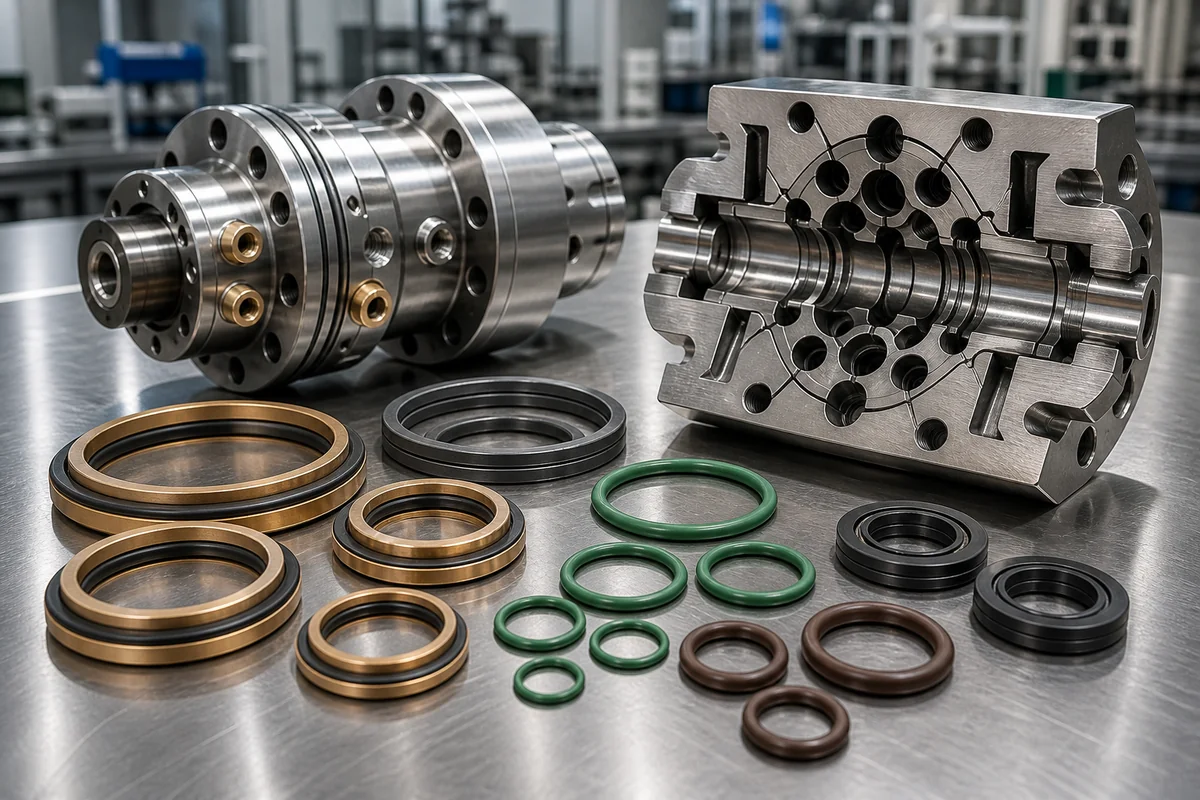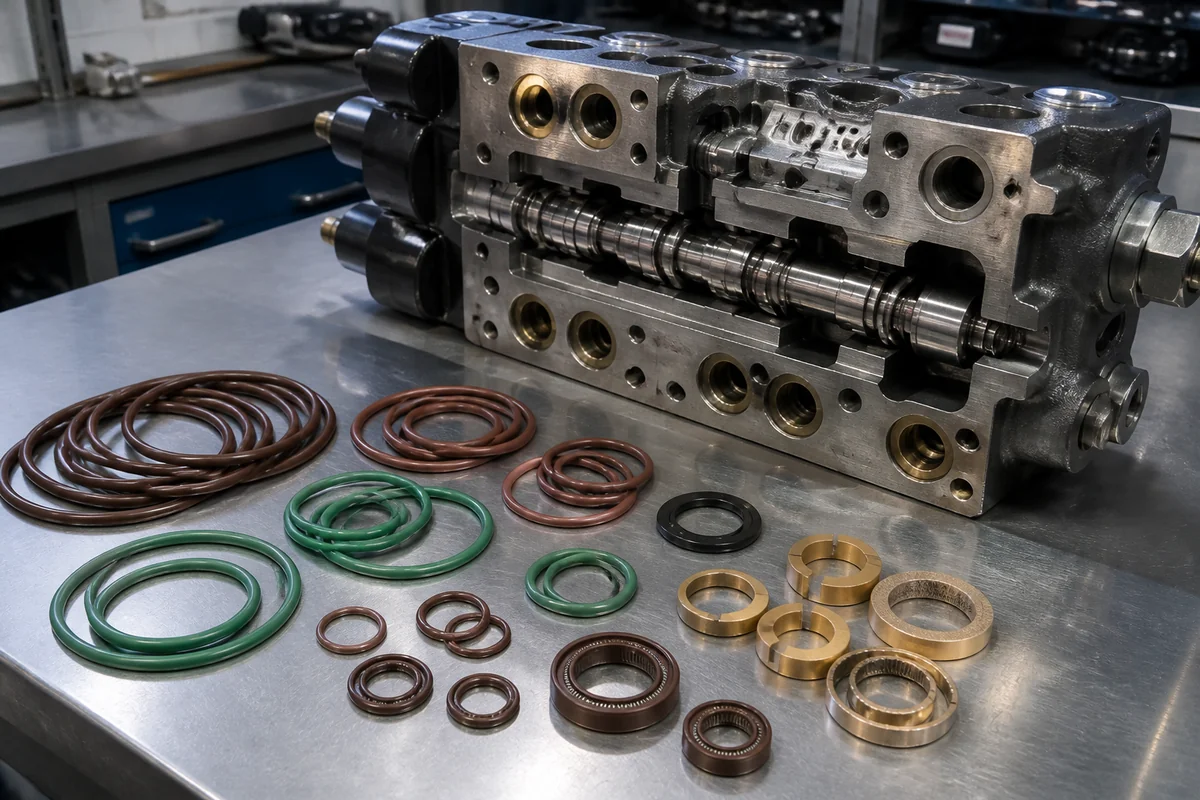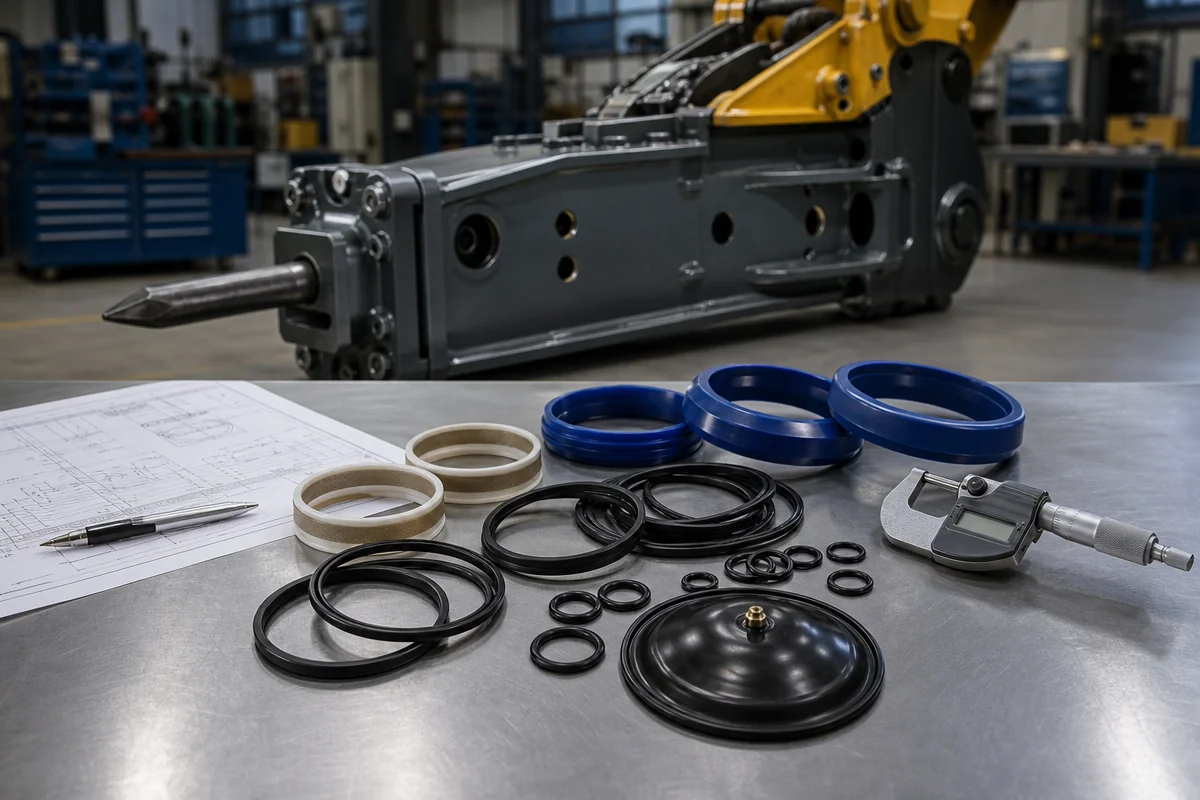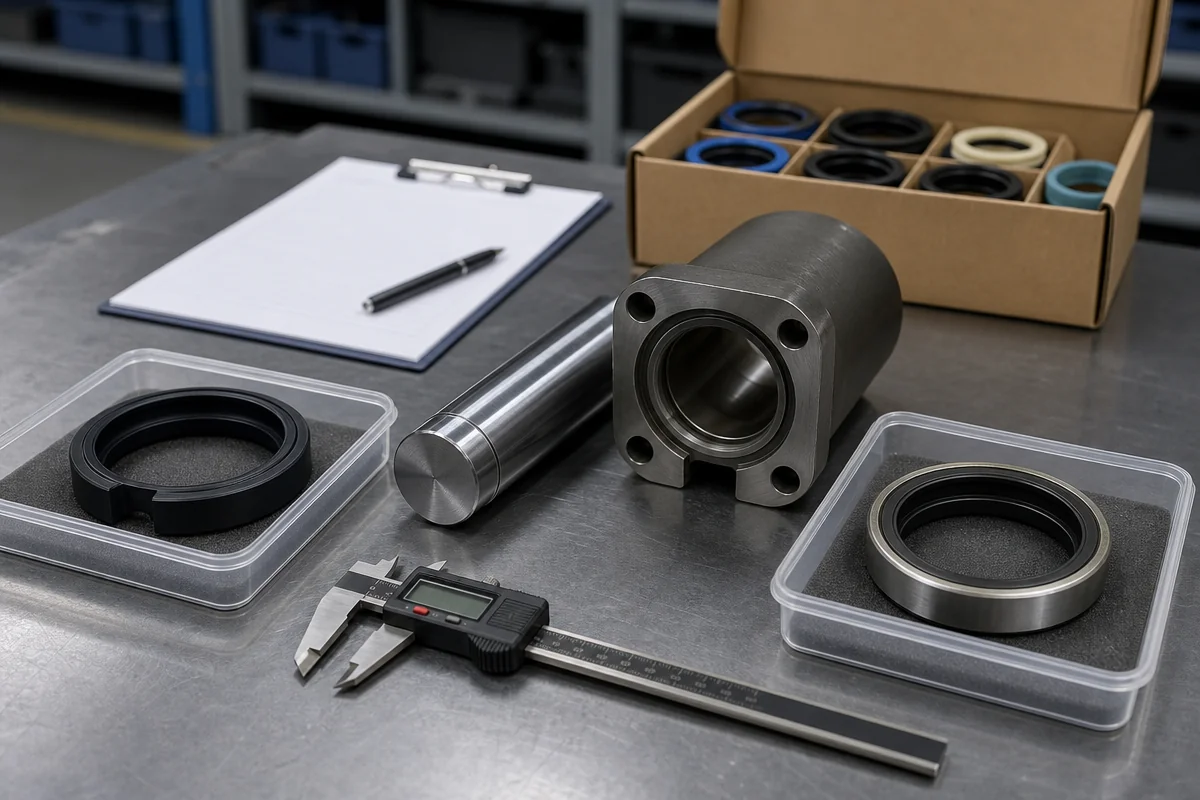
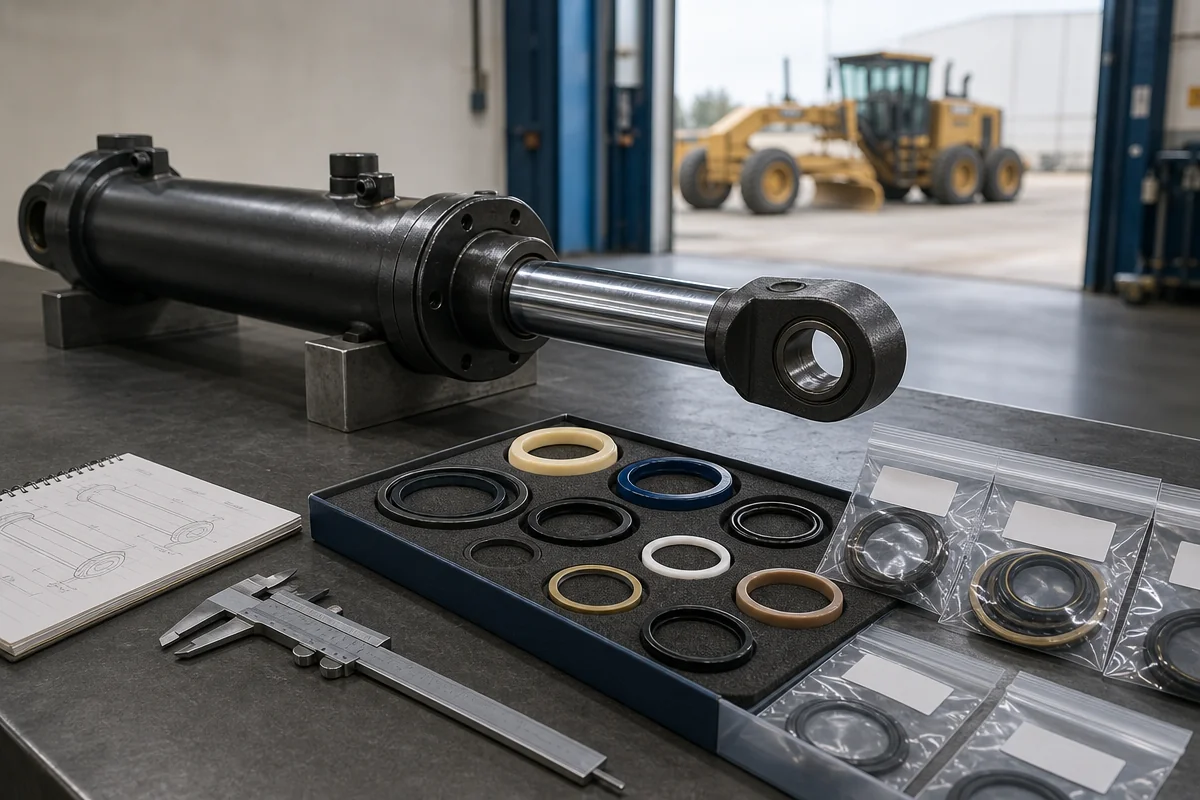
A motor grader hydraulic cylinder seal kit is a matched set of sealing and guiding components – rod seals, piston seals, wipers or scrapers, wear rings, O-rings, back-up rings and related support parts – selected for one specific cylinder bore, rod size, groove profile and seal stack on a grader. For B2B buyers, the working conclusion is straightforward: the part number is a starting reference, not a specification. Moldboard or blade lift, circle rotation and side shift, wheel lean, articulation, steering, and scarifier or ripper cylinders on the same machine can carry different sealing arrangements, and a kit that satisfies one function may be wrong for the next.
This guide is written for procurement teams, hydraulic repair shops, project companies and aftermarket distributors who purchase motor grader cylinder seal kits in volume. It is a buying framework, not a retail parts page: how to map each cylinder function, what a complete RFQ must contain, how a kit is verified before production, and how a matched kit compares with an approximated one.
Field Signals: Why Motor Grader Hydraulics Stay on the Repair Agenda
Motor graders work long shifts on compacted, abrasive and often contaminated surfaces. The moldboard and circle group is loaded almost continuously, the front frame articulates under steering and grade correction, and the rear can carry a scarifier or ripper that absorbs impact whenever a tooth meets a hard obstruction. That duty profile keeps cylinder sealing surfaces, wipers and guide elements in constant contact with dust, fines and road grit.
Buyers should also read the market signal correctly. Recent forum activity keeps motor-grader hydraulic troubleshooting visible among operators and mechanics – a Heavy Equipment Forums discussion dated 2026-09-02 on motor grader hydraulic faults is a current example of that ongoing attention. That thread should be understood as evidence that owners and technicians are still working through grader hydraulic issues, not as a seal-failure statistic and not as proof of any single root cause. Anecdotes from a forum, a service truck or a single machine are useful leads, and nothing more.
For a B2B buyer, that framing matters commercially: demand is driven by service events rather than a fixed replacement calendar, so orders arrive at short notice with mixed cylinder references and incomplete documentation. The correct response is not to guess the closest kit, but to confirm the cylinder condition through inspection and teardown data before committing to a production quantity.
The Motor Grader Cylinder Map: Six Functions, Six Sealing Decisions
A grader is not one hydraulic circuit repeated along the frame; it is a set of cylinders with different strokes, load directions, holding requirements and exposure. Treating them as interchangeable is the most common way a seemingly minor purchasing shortcut turns into a comeback. The mapping below is qualitative by design – exact bore, rod, groove and material data must be confirmed from the serial or model reference and from teardown data for the specific machine in front of you.
Moldboard and Blade Lift Cylinders
Lift cylinders set and hold blade height, so they spend much of their life under static or slowly changing load while the machine pushes material. Rod seals and wipers face continuous abrasive spray, and rod surface condition strongly influences whether a new kit will hold. Confirm rod diameter, bore, stroke and rod finish condition, and record whether both lift cylinders are being rebuilt together.
Circle Rotation and Side Shift Cylinders
These cylinders reposition the moldboard to change cutting angle and reach, and they often move under load and under partial stroke, which concentrates wear in a limited band. Confirm the exact function, because circle rotation hardware and side shift cylinders are separate assemblies with separate sealing requirements on most graders.
Wheel Lean Cylinders
Wheel lean tilts the front wheels to resist side thrust when cutting on a slope or in a windrow. Lateral and thrust loading means guide and wear-ring elements matter as much as the elastomeric seals. Confirm whether the machine uses a single or paired arrangement and what the current wear pattern shows.
Articulation Cylinders
Articulation cylinders carry high force in a dusty, exposed location, and bore and rod sizes here often differ noticeably from the blade group. Alignment around the articulation joint can affect seal life, so confirm frame and pin condition alongside the cylinder data.
Steering Cylinders
Steering cylinders are safety relevant: leakage or drift changes how the machine responds. This function deserves the strictest verification and the clearest documentation, with cylinder identification and receipt inspection criteria agreed in advance.
Scarifier and Ripper Cylinders
Rear attachment cylinders take impact loading and heavy debris exposure when the teeth engage hard material, so wipers, scrapers and rod protection elements are critical. Confirm tooth and shank configuration, cylinder identification and operating environment before quoting.
| Cylinder function | Load character in service | Sealing and guidance focus | Confirm before quoting |
|---|---|---|---|
| Moldboard / blade lift | Holding load, slow movement, abrasive spray | Rod seal, wiper or scraper, rod finish condition | Rod, bore, stroke, groove profile from teardown data |
| Circle rotation and side shift | Movement under load, partial stroke wear band | Piston seal, wear ring, localized wear assessment | Exact function, assembly identity, wear pattern |
| Wheel lean | Side thrust and lateral loading | Guide and wear elements with elastomeric seals | Single or paired arrangement, current wear evidence |
| Articulation | High force, exposed and dusty location | Large bore sealing, contamination resistance | Cylinder identity, joint and pin condition |
| Steering | Continuous correction, safety relevant | Full stack integrity, documented inspection | Cylinder identification and acceptance criteria |
| Scarifier / ripper | Impact load, heavy debris exposure | Wiper and scraper protection, rod guarding | Attachment configuration and operating environment |
Why a Part Number Is Not the Whole Specification
Part numbers are genuinely useful: they anchor the conversation, help a distributor search a catalogue, and often point to the cylinder family a machine uses. They are not proof of fit. Numbers get superseded, interchanged and re-used across build breaks, machines get rebuilt with non-original rods, and a cylinder may be replaced by an assembly with similar external dimensions but a different internal groove profile.
Several failure modes follow from treating a number as a specification:
- Supersession drift. A number that was correct for one build period may map to a different internal arrangement in another.
- Rod replacement history. A re-chromed or aftermarket rod changes the surface finish and sometimes the nominal size tolerance band.
- Function confusion. Kits for lift, lean, articulation and steering cylinders are not interchangeable even when external dimensions appear close.
- Groove profile mismatch. A seal that fits the bore but not the groove profile will not seat, preload or retain correctly.
- Material assumption. Two cylinders on one machine may see different fluids, temperatures and contamination levels, which argues for different compounds.
The correct posture for a B2B buyer is to use the part number as a search key and the physical data as the specification. If the measurement workflow is new to your team, the practical sequence is set out in our guide to how to measure hydraulic seals and plan a replacement, which pairs well with the RFQ structure below.
What a Complete Motor Grader Seal Kit RFQ Must Contain
The single biggest cause of quotation delay and rework in grader seal sourcing is an incomplete request. A supplier given a bare part number can only quote an assumption; a supplier given a structured data package can quote a verified kit. The package below is the minimum for a production enquiry.
Machine and cylinder identity
- Machine serial number and model reference, plus the build or configuration detail available to you.
- Cylinder function and position on the machine, using the grader-specific terms in the map above.
- Whether the enquiry covers one cylinder type, several functions, or a planned multi-machine program.
Dimensional and internal data
- Rod diameter and bore measurement, taken with calibrated instruments and recorded with the method used.
- Groove profile and seal stack arrangement: seal type, element order, and the components present in the original assembly.
- Stroke and mounting detail where the cylinder has been replaced or modified.
Sealing system and operating conditions
- Fluid type in use and any recent change to fluid specification.
- Operating environment: dust, road grit, quarry fines, slurry, temperature range and seasonal variation.
- Observed failure pattern and what the failed parts looked like when removed.
Evidence, quantity and acceptance
- Photos of the cylinder, the rod, the bore, the groove and the removed seal stack at a scale that allows interpretation.
- The old parts themselves where they can be shipped; physical evidence resolves ambiguity faster than photographs.
- Quantity per order, expected repeat demand, and inspection or documentation requirements the buyer will apply.
| RFQ data item | Why the supplier needs it | If it is missing | Priority |
|---|---|---|---|
| Serial and model reference | Narrows the cylinder family and build variation | Quotation becomes a family-level assumption | High |
| Cylinder function and position | Separates lift, circle, lean, articulation, steering and rear attachments | High risk of a kit built for the wrong circuit | High |
| Rod and bore measurements | Defines the sealing envelope and clearances | Fit cannot be confirmed; only guessed | High |
| Groove profile and seal stack | Ensures elements seat, preload and retain correctly | Seals may assemble but fail in service | High |
| Seal material and fluid | Drives compound selection for compatibility | Default material may not suit the application | High |
| Operating environment | Guides wiper and contamination strategy | Protection elements may be underspecified | Medium |
| Photos and old parts | Confirms configuration and failure pattern | Questions remain open until parts arrive | High |
| Quantity per order | Sets tooling, batch and packing decisions | Pricing and schedule cannot be committed | Medium |
| Inspection and documentation needs | Aligns output with the buyer acceptance process | Goods may arrive without usable records | Medium |
Where dimensional tolerance questions come up early, the supplier and buyer should agree on how dimensions and tolerances will be validated rather than debating them after delivery. The framework in our article on hydraulic seal kit dimensions and tolerance validation is a useful agenda for that conversation.
The Seal-Kit Verification Workflow Before You Commit to Production
A verified kit is the result of a sequence, not a single check. The stages below describe how a manufacturing supplier should move from an enquiry to a released kit, and what the buyer should expect to see at each gate. Skipping a stage usually reappears later as a rejected shipment, a field comeback, or an expensive emergency air freight.
The stages are sequential, and each one produces a record that the next stage depends on. Buyers should insist on receiving those records rather than verbal assurances, because the records are what makes a second order repeatable.
| Verification stage | Activity | Evidence produced | Gate decision |
|---|---|---|---|
| 1. Intake review | Check the RFQ against the required data set | Consolidated data gap list | Proceed or return to buyer for data |
| 2. Measurement reconciliation | Compare buyer readings with reference data | Comparison record with deviations listed | Resolve deviations before design freeze |
| 3. Groove and stack confirmation | Verify profile and original element order | Confirmed stack drawing or marked-up photo | Configuration frozen for quoting |
| 4. Material selection | Match compound to fluid, environment, duty | Material rationale per cylinder function | Material set approved for sampling |
| 5. Sample build | Produce a physical kit for the confirmed build | Sample kit with identification marking | Sample released for buyer review |
| 6. Sample fit trial | Check sample against rod, bore, groove, order | Trial result and any adjustment note | Fit accepted or sample revised |
| 7. First article and batch | Agree production and inspection criteria | Approved first-article reference | Production quantity released |
| 8. Documentation release | Issue records, packing and marking detail | Shipment documentation package | Receiving inspection enabled |
Replacement-Risk Comparison: Matched Kit, Nearest Number, Generic Assortment
Every purchasing shortcut has a cost, and the cost is usually paid in machine downtime rather than in unit price. The comparison below is deliberately about risk exposure, because that is what separates a cheap kit from an inexpensive one.
| Sourcing approach | Fit confidence | Downtime risk | Rework exposure | Documentation | Best used for |
|---|---|---|---|---|---|
| Kit matched to confirmed teardown data | Highest available | Lowest | Lowest | Full record trail | Planned rebuilds and program orders |
| Nearest part number substitution | Unverified | Moderate to high | High if the groove differs | Limited | Emergency use only, with teardown check |
| Generic assortment box | Not confirmed for the cylinder | High | High | Minimal | Non-critical, low-load circuits only |
| Mixed sourcing per cylinder function | Variable by function | Variable | Administrative and fit risk | Fragmented | Buyers with strong in-house inspection |
For most grader fleets the matched kit is not the expensive option; it is the one that keeps a machine out of a second teardown. One unplanned removal of a loaded moldboard cylinder costs far more in labour and lost production than the price difference between a verified kit and a guessed one.
Sample Approval and First-Article Practice for B2B Programs
Sample approval is where a B2B seal program is either protected or exposed. Its purpose is not to delay the order but to convert assumptions into a physical reference that both parties have seen. A workable process looks like this:
- Define the sample scope. Confirm which cylinder functions it covers and whether a separate sample is needed for each distinct sealing arrangement.
- Agree acceptance criteria in advance. Dimensions, element order, material identification and marking should be stated before the sample ships, not judged on arrival.
- Record the trial result. If the sample is fitted on site, document what was observed, including any interference or element order question.
- Freeze the approved configuration. The approved sample becomes the production reference, and any later change is a deliberate, recorded decision that applies to repeat orders as well.
Buyers running multiple machines should keep a kit register: machine reference, cylinder function, confirmed configuration, approval date and sample reference number. That register removes the most common source of repeat errors, which is re-quoting a rebuild from memory.
Selecting the Right Manufacturing Partner for Grader Seal Programs
For a wholesale or project-scale buyer, the supplier matters as much as the kit. A supplier who can read teardown data, question an incomplete RFQ and support sample approval will reduce your engineering workload. A trading intermediary who can only forward a part number will increase it.
When comparing manufacturers, look at the evidence behind the offering rather than the range of numbers quoted. Our checklist on vetting a hydraulic seal supplier sets out five indicators worth applying to any shortlist. Buyers who want to review the component families available for construction machinery can start from the hydraulic seals product range, then request a configuration review for the specific grader cylinders in their fleet.
Three practical questions separate serious suppliers from the rest:
- Can they explain why a given compound suits a given cylinder function, or do they only quote what is in stock?
- Do they ask for teardown data, or do they accept a part number as sufficient?
- Do they offer a documented sample and first-article process, or only a shipment?
Frequently Asked Questions
Can I order motor grader cylinder seal kits from the part number alone?
You can request a quotation from a number, but not a production commitment. Numbers are a search key: confirm the cylinder function, rod and bore measurements, groove profile and seal stack from the machine, and check whether the cylinder or rod has been replaced with non-original parts.
Do all cylinders on one grader use the same seal materials?
Not necessarily. Lift, circle, wheel lean, articulation, steering and scarifier cylinders see different loads, exposure and duty cycles, so material selection should follow the function and its operating environment rather than one default compound.
How should a B2B buyer compare quotations from several suppliers?
Compare what is verified, not only the price. Ask what data the supplier used, whether a sample is provided, what inspection records accompany the shipment, and how repeat orders stay consistent with the approved reference.
What if the old seals are damaged and unreadable?
Provide as much remaining structure as possible: partial elements, groove photographs, rod and bore measurements and the cylinder identification. Where photographs are ambiguous, shipping the old parts for physical review is the fastest route to a confirmed configuration.
Can kits be prepared for scheduled shutdowns?
Yes, and this is the most cost-effective way to buy. Supply the cylinder list in advance so configurations can be verified, samples approved and quantities prepared before the machine is taken out of service, and confirm the timing with your supplier.
How do we confirm the right kit for a machine we have not serviced before?
Start from the serial and model reference to narrow the cylinder family, then confirm from teardown data before ordering. Past repairs and build variations can change the internal arrangement even when the external cylinder looks familiar.
Conclusion
Motor grader hydraulic cylinder seal kits are function-specific parts, not commodity items. The moldboard and blade lift group, circle rotation and side shift, wheel lean, articulation, steering and rear scarifier or ripper cylinders each impose different sealing, guiding and protection requirements, and each should be sourced against confirmed data rather than an assumed number.
For B2B buyers, the process that protects production is predictable: map the cylinder function, assemble a complete RFQ covering machine identity, cylinder identity, rod and bore measurements, groove profile, seal stack, fluid, operating environment, photographic and physical evidence, quantity and inspection requirements; verify the kit through sample approval and first-article agreement; and confirm every configuration from the serial or model reference together with teardown data before you commit to a production order.
Do that, and the kit you receive is the kit your machine needs. Skip it, and the saving is temporary while the risk is not.
Ready to build a verified motor grader seal kit program? Send your cylinder list, machine references and teardown notes through our contact page and our team will review the configuration with you before quoting.