
Wear Rings and Guide Rings in Hydraulic Cylinders: Functions, Materials, and When to Replace Them
Every hydraulic cylinder rebuild comes down to more than the seals themselves. Between the piston and the barrel, and between the rod and the gland, sit components that rarely appear on a beginner’s parts diagram: wear rings and guide rings. Often shipped inside the same seal kit, these non-sealing rings carry the radial load that elastomer seals are not designed to absorb. For hydraulic seal kit distributors, repair shops, and construction equipment maintenance teams, understanding wear rings hydraulic cylinder applications is the difference between a rebuild that lasts and a comeback job. This guide explains what wear rings and guide rings do, how they protect the sealing system, which guide ring material fits which application, how to inspect and replace them, and what to ask a supplier before a bulk inquiry.
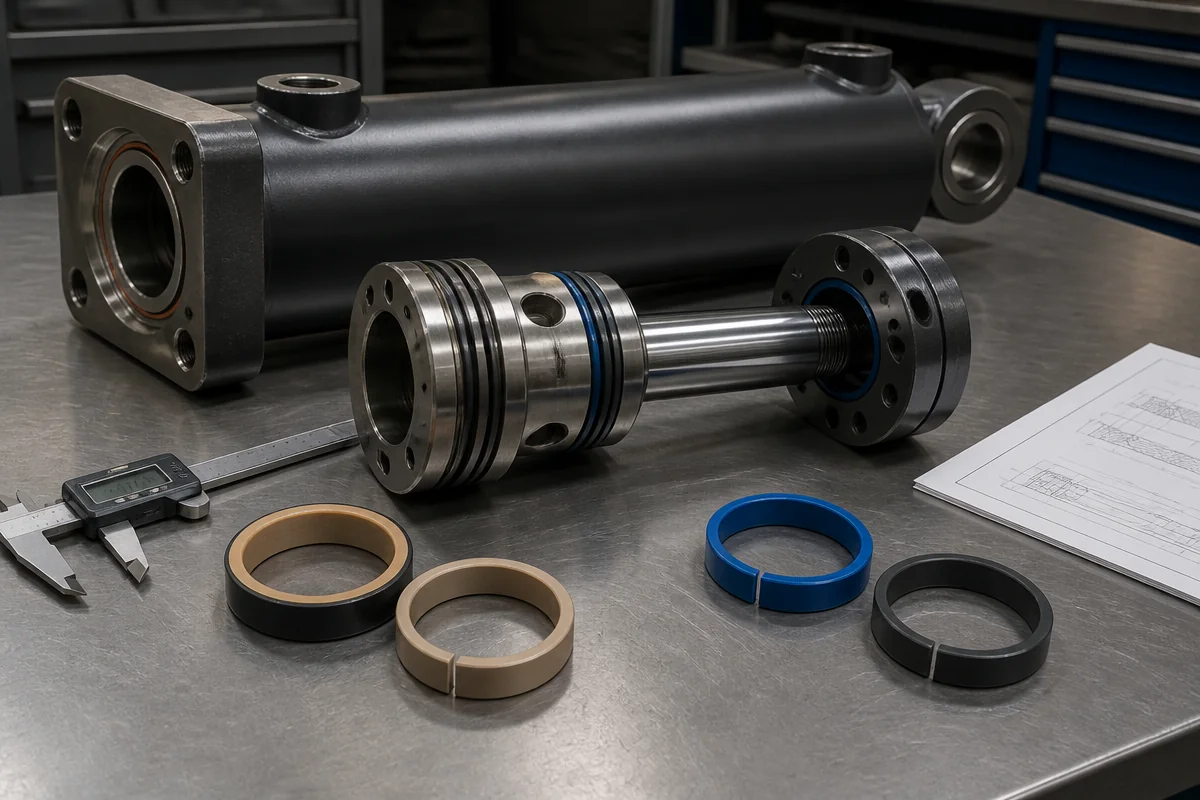
Wear rings vs. guide rings: what’s the difference?
In most catalogues, “wear ring” and “guide ring” describe the same family of components, also called bearing rings or glide rings. Wear ring is the generic term for a ring-shaped bearing element that supports a piston or a rod inside the cylinder. Guide ring (or guide band) is the term used when the guiding function is emphasized — it is common on the rod side, where the part is also called a rod bearing or a gland bearing.
The practical difference is position and terminology, not function. Both are structural support elements: they keep the piston and rod concentric with the bore, absorb side loads from the working attachment, and prevent metal-to-metal contact between moving surfaces. Neither is a sealing element. This distinction matters when ordering hydraulic cylinder guide rings: piston-side and rod-side rings often have different dimensions, profiles, and materials even inside the same cylinder, so a supplier needs to know exactly which position the ring comes from.
Why wear rings matter to the sealing system
Seals fail in two classic ways: extrusion and abrasion — and a worn guide ring accelerates both. When a cylinder extends under load, the piston is pushed sideways against the bore. The wear ring holds the piston in position so the radial gap between piston and barrel stays within the design clearance. As the ring wears, the piston tilts, the gap on the loaded side grows, and the piston seal begins to extrude into the opening on every pressure cycle. On the rod side, the same story plays out: a worn guide ring lets the rod rock in the gland, and the rod seal lip scrubs unevenly against an eccentric surface.
This is why wear rings are part of the sealing system, not an optional extra. In many early seal failures, the root cause is not the seal at all — it is a worn or missing bearing ring that allowed the seal to be overloaded. Our guide on common hydraulic cylinder seal failures covers the failure patterns; here we focus on the components that prevent most of them.
Where wear rings and guide rings sit in a hydraulic cylinder
Piston wear rings
Piston wear rings are mounted in grooves machined into the outside diameter of the piston, usually one or two rings per piston. They support the piston inside the barrel and keep the piston seal and the pressure-separating seal elements centered. Without them, the piston would contact the barrel wall directly, scoring the bore and generating metal particles that contaminate the entire system. Piston wear ring replacement is normally done as part of a full re-seal, because the ring shares the same disassembly work as the seals.
Rod guide rings
Rod guide rings sit inside the gland (head) of the cylinder, around the rod. They guide the rod as it extends and retracts, and they absorb the side loads that come from buckets, booms, and attachments pressing against the rod. Their main job is to protect the rod seal and the rod surface: a rod that is held on center wears its seal evenly, while a rod that rocks sideways chews through seal lips and can damage the chrome plating.
In both positions, the ring performs the same four functions:
- support radial (side) loads so seals are never the load-bearing element;
- maintain concentricity between the moving part and the bore or gland;
- prevent metal-to-metal contact between piston and barrel or rod and gland;
- hold the extrusion gap at the seal groove within the design clearance.
Guide ring materials compared
Choosing a guide ring material is a compromise between load capacity, friction, hardness, and the mating surface finish. Material formulations vary significantly between manufacturers, and the same family name (for example, “PTFE with bronze”) can behave differently depending on filler ratio and processing. The table below summarizes common families — treat it as a starting point, and confirm the final selection against the cylinder drawing, the operating conditions, and a sample test.
| Material | Typical composition | Key characteristics | Common positions | What to confirm before ordering |
|---|---|---|---|---|
| PTFE + bronze | PTFE base with bronze filler | Low friction, low stick-slip, wide compatibility with fluids; relatively soft, so it wears gradually instead of damaging the rod | Rod guide rings in most construction cylinders | Bronze filler ratio, hardness, clearance to the rod/bore |
| PTFE + carbon/graphite | PTFE base with carbon or graphite fillers | Very low friction, good dry-running behavior, less abrasive to mating surfaces; higher cost than bronze-filled grades | Rod guide rings, low-lubrication or precision applications | Whether the application truly needs dry-running performance |
| Filled acetal (POM) | Acetal copolymer with internal lubricants or fillers | Rigid, dimensionally stable, low moisture absorption; harder than PTFE grades, so fit and clearance must be correct | Piston wear rings under moderate side load | Running clearance and thermal expansion behavior |
| Cast nylon (PA6/PA6G) | Cast polyamide, often with oil or MoS₂ additives | Tough, economical, good wear resistance in abrasive environments; absorbs moisture, which changes dimensions slightly | Heavy-duty piston wear rings | Moisture-conditioned dimensions and installation clearance |
| Fabric-reinforced phenolic | Cotton or fabric laminate with phenolic resin | High compressive strength, low friction, the classic heavy-duty piston guide; edges are brittle and need proper chamfers | Large bore piston rings, high side-load applications | Chamfer/bevel profile and groove edge break |
| Bronze (solid or sintered) | Bronze alloy rings | Very high load capacity and heat tolerance; metal-on-metal risk requires good lubrication and fine surface finish | Special high side-load or high-temperature cylinders | Lubrication, surface finish of the rod/bore, and clearance |
No material is “best” in isolation. The right choice depends on the cylinder design, the side load magnitude, operating speed and temperature range, the hydraulic fluid, and the surface finish of the mating components. Because filler ratios and processing differ from one manufacturer to another, the final guide ring material should always be verified against the OEM drawing or confirmed with the supplier using a sample before a production order.
Common wear symptoms and what they mean
Wear rings fail gradually, and the first signals usually appear elsewhere. Watch for these signs when a cylinder comes in for service:
- Scoring or fine lines on the rod or barrel — indicates contamination particles embedded in the ring, or a ring material that is too hard for the surface finish;
- Uneven, flat-spotted, or polished areas on the ring — the ring has been carrying higher local loads than designed, often from an off-center cylinder mount or a bent rod;
- Chips, cracks, or splits in the ring — brittle material, impact loads, or a groove with sharp edges instead of the required edge break;
- Metal particles in the drained oil — usually means metal-to-metal contact has already started, which a healthy ring prevents;
- Knocking or side-load noise during extension under load — the piston or rod is moving off-center and contacting the bore or gland;
- Cylinder drift or sagging under load — excessive clearance lets internal leakage paths open past the piston;
- Visible play between piston and barrel when disassembled — the surest sign that the ring has worn below its working clearance.
A light polishing of the ring surface is normal in service. The problem starts when wear produces measurable clearance growth, embedded contamination, or transferred metal. If you see scoring on the rod or barrel, inspect the ring before blaming the seals — the ring damage usually happened first.
Inspection process: how to check a piston wear ring
Checking a wear ring does not require laboratory equipment, but it does require method. The steps below work for both piston and rod-side rings:
- Depressurize the cylinder completely and block the equipment so it cannot fall or move.
- Disassemble the cylinder and remove the piston and gland, keeping the parts in order.
- Clean the ring and its groove, then examine the ring surface for scoring, flat spots, chips, and embedded particles.
- Measure the ring outside diameter and compare it with the bore diameter; measure the ring width against the groove width.
- Check the ring profile — tapered, stepped, or straight — against the drawing or the original part.
- Inspect the mating surfaces: the barrel wall and the rod for scoring, wear steps, or chrome damage.
- Record all measurements and take photos of the ring and its groove before cleaning them away.
- Compare your numbers with the cylinder drawing or the supplier’s data sheet before deciding to replace.
Because a distorted or worn ring no longer shows its original dimensions, measure the groove in the piston or gland whenever possible instead of relying only on the used ring. Our practical guide on how to measure hydraulic seals explains the measurement techniques and tools that apply here as well.
When to replace wear rings and guide rings
There is no universal service interval for wear rings — their life depends on side load, contamination control, surface finish, and material, none of which are the same across machines. The responsible practice is to evaluate each cylinder at service time and replace when any of the following is true:
- the cylinder is being re-sealed anyway — replacement is standard practice on a full rebuild, since the ring costs a fraction of the labor;
- the ring shows metal contact marks, embedded contamination, cracks, or flat spots;
- measured clearance exceeds the tolerance on the cylinder drawing;
- the rod has been re-chromed or the barrel honed, which changes the running clearance the original ring was fitted for;
- the cylinder has been drifting or sagging under load;
- the service history is unknown, as with used or exchanged cylinders.
When in doubt, replace. Reusing a borderline wear ring to save a few dollars commonly leads to a second disassembly weeks later — this time with a scored rod or barrel that costs far more to repair.
Risks of buying the wrong hydraulic cylinder wear ring
A wear ring looks like a simple plastic band, but the wrong one can damage the entire cylinder. Common procurement mistakes and their consequences:
- Wrong material — a ring that is too hard can score the rod or barrel; one that is too soft can extrude into the clearance gap or wear out in weeks;
- Wrong dimensions — an oversized ring binds and generates heat; an undersized ring allows metal contact and seal overload;
- Wrong profile — mixing up straight, tapered, and stepped profiles changes the running clearance and the load distribution;
- Wrong filler ratio — two “PTFE + bronze” rings from different sources are not automatically equivalent;
- Untraceable lookalikes — cheap no-name rings without batch records make it impossible to reproduce a good order or investigate a failure;
- Cross-reference errors — the same OEM part number can cover multiple revisions of a cylinder, so dimensions should always be verified on the actual part or drawing;
- Inconsistent bulk batches — a distributor’s reputation depends on every box in a batch matching the sample, which is why material and dimension verification matters for bulk orders.
These risks are exactly why experienced buyers treat the hydraulic cylinder wear ring as a critical component with its own specification, not as an accessory bundled into a kit without verification.
B2B supplier inquiry checklist for wear rings and guide rings
When you are sourcing wear rings and guide rings — for your own stock, for a repair program, or to complete seal kits you distribute — send the supplier enough information to quote correctly the first time:
- cylinder make, model, and position (piston or rod side);
- bore diameter and rod diameter;
- ring groove width, depth, and location;
- ring width, thickness, and profile (straight, tapered, stepped);
- preferred guide ring material and filler, or the material currently installed;
- operating conditions: side load, speed, temperature range, hydraulic fluid type;
- the OEM part number for cross-reference, plus photos or a drawing if available;
- required quantity and expected ordering frequency, so the supplier can propose packaging that suits your warehouse;
- request for quality records and batch traceability on production lots;
- confirmation of MOQ, lead time, and sample policy before the first order.
For OEM/aftermarket cross-reference work, provide the original part number and any revision markings from the old ring. A reliable supplier will cross-reference the number but still confirm dimensions against your sample or drawing — this step prevents the revision errors that cause the most warranty returns. For bulk orders, ask how the supplier documents material batch, dimensional inspection, and packaging so that every shipment matches the approved sample.
FAQ
Are wear rings and guide rings the same part?
Yes, in most cases they are the same family of components. “Wear ring” is the generic name, while “guide ring” emphasizes the guiding function and is often used on the rod side. What matters for ordering is the exact position, dimensions, and material — not the name.
Can I reuse a wear ring during a re-seal?
Reuse is not recommended. A ring that has been in service has already worn to a new clearance, and re-fitting it means rebuilding the cylinder to unknown dimensions. The cost of a new ring is small compared with a second disassembly.
Why does my piston wear ring wear out quickly?
Fast wear usually points to contamination in the oil, an off-center cylinder mount or bent rod creating excessive side load, a ring material that is too soft for the load, or insufficient clearance causing scuffing. Check the rod and barrel for scoring, and review the operating conditions with your supplier before simply ordering the same part again.
PTFE or nylon — which guide ring material is better?
Neither is universally better. PTFE grades offer lower friction and better compatibility with the rod surface; cast nylon offers toughness and economy in abrasive environments. The right choice depends on side load, surface finish, fluid, and temperature — confirm it against the cylinder drawing and a sample, not a general rule.
Do I need to replace guide rings every time I change seals?
It is the recommended practice on a full re-seal, and it is what most rebuild programs standardize on. If the ring measures within drawing tolerance and shows no damage, some shops re-use it, but the labor savings are minimal and the risk of a second teardown is real.
How do I know the right wear ring size if the OEM number is gone?
Measure the ring groove in the piston or gland, not the worn ring itself. Record the bore or rod diameter, groove width and depth, and the ring profile, then send the numbers and photos to your supplier. This is the same measurement discipline used for seals and described in our seal measurement guide.
Source wear rings and guide rings for your hydraulic cylinder seal kits
Wear rings and guide rings should never be an afterthought in your rebuild program. Distributors, repair shops, and fleet maintenance teams that standardize on verified rings with proper documentation get consistent rebuilds — and fewer comebacks.
When you are ready to order, send your cylinder details, drawings, or OEM part numbers to the DJF Seals team for cross-reference and a quotation. Whether you need a single reference sample or a bulk supply program, we can discuss material selection, MOQ, packaging for your warehouse, and the quality records you need to document every batch. Bulk inquiries are welcome — include your cylinder list and target quantities so we can respond with a complete proposal.
 Excavator Center Joint (Swivel Joint) Seal Kits: Internal Cross-Port Leakage Troubleshooting, PTFE Step-Seal Selection & B2B Overhaul Guide
 Excavator Main Control Valve Seal Kits: Spool Leakage Troubleshooting, Material Selection & B2B Sourcing Guide
 Hydraulic Breaker Hammer Seal Kits: B2B Sourcing, Material Selection, and High-Frequency Shock Protection Guide
 Motor Grader Hydraulic Cylinder Seal Kits: A B2B RFQ and Selection Guide