
Floating Seals (Duo-Cone Seals) for Construction Equipment: Applications, Installation, and Wholesale Sourcing Guide
Floating seals, also called duo-cone seals or mechanical face seals, protect the rotating parts of construction equipment that work in mud, dust, water, and abrasive material. They are different from the rod seals and piston seals used in hydraulic cylinders. A floating seal is a mechanical face-sealing system designed to retain lubricant inside an undercarriage or final-drive assembly while preventing outside contamination from entering. For B2B distributors, equipment repair shops, and fleet maintenance teams, understanding helps prevent one of the most expensive undercarriage failures: lubricant loss followed by bearing, roller, or final-drive damage. The component itself may look simple, but its performance depends on the seal-ring finish, O-ring fit, housing condition, installation cleanliness, and correct compression. This guide explains how duo-cone seals work, where they are used, how to identify failure, how to install them correctly, and what wholesale buyers should confirm before choosing a supplier.
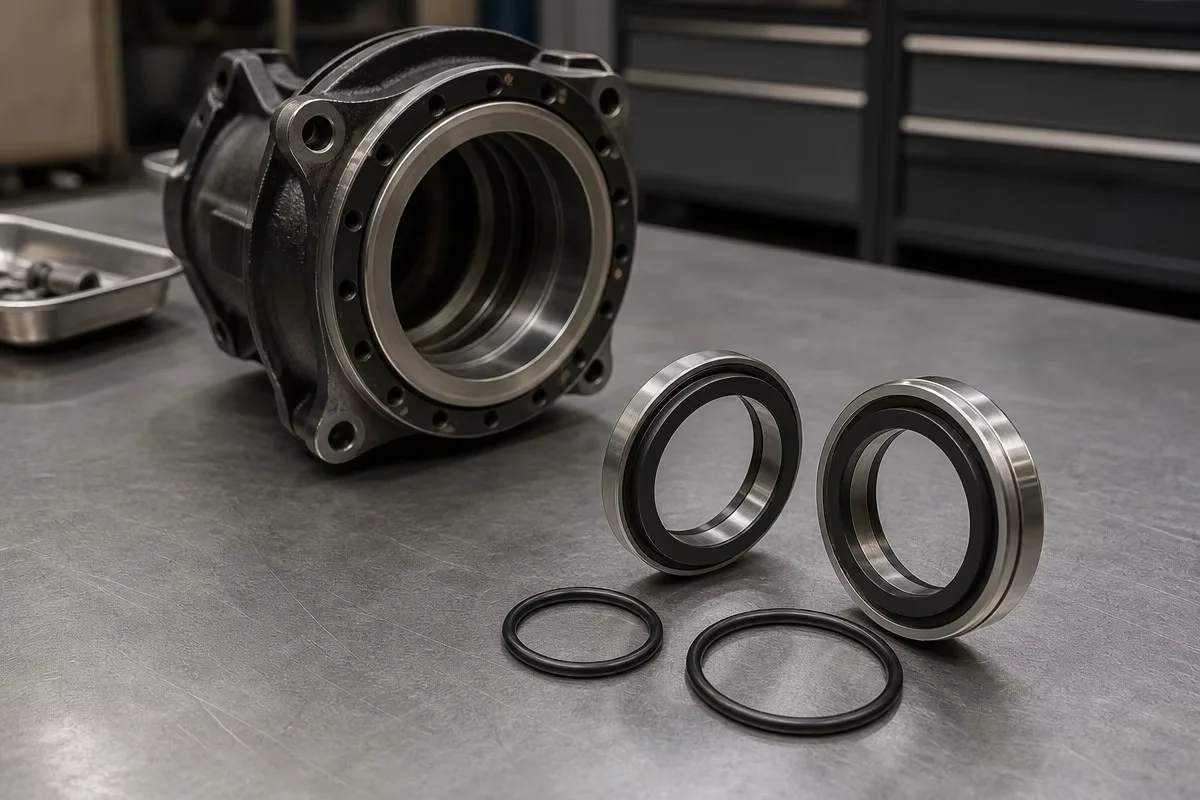
What Are Floating Seals?
A floating seal normally consists of two matched metal seal rings and two elastomer O-rings. The rings are installed face-to-face in two opposing housings. The O-rings center and energize the rings while allowing controlled axial movement as the assembly rotates and heats during operation. The two precision-machined faces create the primary sealing interface. One ring rotates with the assembly and the other remains stationary relative to the opposing housing. A thin lubricant film between the faces reduces wear while the contact pressure prevents oil from escaping. The O-rings provide a secondary seal between each metal ring and its housing. This arrangement is valuable where conventional lip seals would be exposed to extreme abrasion, shock, or continuous immersion in mud. Floating seals do not replace hydraulic cylinder seals; they serve a different purpose in track rollers, idlers, final drives, axles, and other rotating assemblies.
Where Are Duo-Cone Seals Used?
Floating seals are commonly found in the undercarriage and drive systems of tracked construction and mining equipment. Their exact application depends on the machine design and the component supplier, so buyers should verify the part number and dimensions rather than relying only on the machine family.
Track rollers
Track rollers operate close to the ground and are exposed to mud, stones, water, and abrasive dust. A floating seal helps keep the roller lubricant inside while preventing contaminants from reaching the bearings. A failed roller seal can lead to low lubricant levels, overheated bearings, rough rotation, and accelerated track wear.
Front idlers and recoil assemblies
Front idlers guide the track chain and operate under substantial side loads. Mechanical face seals are used in many idler designs to protect the internal bearing and lubricant cavity. Correct ring seating and O-ring movement are essential because misalignment can create a leak even when the rings are not visibly damaged.
Final drives and travel gearboxes
Final drives transmit high torque to the track sprocket. Floating seals help retain gear oil and isolate the drive from water, dirt, and debris. Because final-drive repairs are labor-intensive, early detection of a seal leak can prevent a larger gear or bearing failure.
Heavy-duty axles and rotating hubs
Some off-highway axles, hubs, and other rotating assemblies use mechanical face seals where contamination resistance and lubricant retention are more important than high-speed lip-seal performance.
How Floating Seals Work Compared with Lip Seals
A lip seal uses a flexible sealing lip that contacts a rotating shaft. A floating seal uses two rigid, precision-machined faces energized by O-rings. The choice depends on speed, contamination, pressure, housing design, lubricant, and available installation space.
| Feature | Floating / duo-cone seal | Conventional lip seal |
|---|---|---|
| Primary sealing interface | Matched metal face rings | Flexible elastomer lip |
| Typical environment | Mud, dust, water, abrasive off-highway work | Cleaner shaft and housing conditions |
| Lubricant retention | Designed for enclosed oil or grease cavities | Depends on lip contact and shaft condition |
| Installation sensitivity | High: face cleanliness and compression are critical | High: lip damage and shaft condition are critical |
| Common failure result | Oil loss, contamination, bearing or gear damage | External leakage or contaminant ingress |
Five Signs a Floating Seal Needs Attention
1. Oil or grease around the roller or final drive
Fresh lubricant around a track roller, idler, or final-drive housing is a strong warning sign. Clean the area first, then inspect after operation to confirm whether the leak is active. Do not assume that every wet area is a seal failure because lubricant can also travel from nearby components.
2. Low lubricant level in the sealed cavity
A low level indicates that lubricant may be escaping through the face seal or another housing joint. Running with insufficient lubricant increases friction and temperature and can damage bearings before the leak becomes obvious.
3. Unusual heat or noise
A failing seal can allow lubricant loss or contamination. Increased heat, rough rotation, grinding noise, or abnormal vibration should be investigated before the component is returned to service.
4. Water or abrasive contamination
Milky lubricant, visible water, or gritty particles indicate that the sealing system is no longer isolating the cavity. Contamination may result from a damaged ring, worn O-ring, housing damage, or incorrect assembly.
5. Visible ring or O-ring damage during disassembly
Chips, cracks, deep scoring, heat discoloration, flattened O-rings, and damaged housing grooves are all reasons to replace or repair the affected components. Reusing a questionable O-ring can compromise a new pair of face rings.
Installation Procedure for Floating Seals
Correct installation is as important as seal quality. The following sequence is a practical workshop framework; the machine and component manufacturer’s service instructions remain the controlling reference.
- Clean the housing completely. Remove old lubricant, dirt, rust scale, and seal fragments from both grooves. Pay attention to the seating shoulders and the O-ring tracks.
- Inspect the housing and ring seats. Check for burrs, dents, corrosion, distortion, and uneven wear. A new seal cannot compensate for a damaged seat.
- Verify the complete set. Confirm that the two metal rings are a matched pair and that both O-rings have the correct profile and size. Keep the components paired during handling.
- Lubricate the O-rings correctly. Use a clean lubricant compatible with the O-ring compound and the service lubricant. Avoid contaminated grease or sharp tools.
- Install the O-rings without twisting. A twisted O-ring can create uneven compression. Seat it evenly in the groove and confirm that it is not trapped under a ring edge.
- Keep the metal faces clean. Do not touch the sealing faces with dirty gloves. Wipe them with a lint-free cloth and use the approved cleaning method.
- Bring the housings together squarely. Avoid tilting or forcing one ring against the other. Uneven assembly can damage the face or push an O-ring out of position.
- Confirm compression and rotation. Check the assembly method and compression measurement specified for the component. Rotate the assembly by hand when permitted to identify binding before adding lubricant.
- Fill with the correct lubricant and test. Use the specified lubricant quantity and inspect for leakage during a controlled test before the machine returns to work.
Common Floating Seal Installation Errors
Touching the sealing faces with contaminated gloves
Fine grit or metal particles between the faces can create a leakage path. Face cleanliness is not cosmetic; it is part of the sealing function.
Mixing unmatched rings
Metal face rings should be treated as matched components. Combining rings from different kits or profiles can create poor contact and uneven wear.
Twisting or stretching the O-ring
A distorted O-ring may not center the ring correctly. It can also create a local gap that leaks under rotation.
Forcing the housing together at an angle
Angular assembly can chip the face, roll the O-ring, or produce uneven compression. Stop and correct alignment instead of using bolts to pull the parts together.
Reusing damaged rings
Polishing or cleaning cannot reliably restore a face ring with cracks, deep grooves, chips, or heat damage. Reuse decisions should be based on the manufacturer’s inspection criteria, not appearance alone.
Wholesale Sourcing Checklist for Floating Seals
B2B buyers should provide enough application information for accurate matching. A supplier should be able to work from an OEM reference, component type, ring dimensions, O-ring dimensions, or a clear sample. Ask the following questions before placing a bulk order:
- Are the two metal rings supplied as a matched set?
- Are the O-rings included, and are their compound and dimensions identified?
- Can the supplier cross-reference the kit to the relevant roller, idler, axle, or final-drive application?
- Are ring face finish, dimensional inspection, and packaging controls documented?
- Can the factory support sample verification before a larger wholesale order?
- Are kits individually labeled for warehouse control and resale?
- Can the supplier provide replacement support when a housing measurement differs from the reference data?
At DJF Seals, we support distributors and repair shops with floating seal sourcing based on verified part references, dimensions, samples, and application information. The correct selection depends on the complete sealing assembly rather than a visually similar ring.
Conclusion
Floating seals protect some of the most heavily exposed rotating assemblies on construction equipment. Their two metal face rings and O-rings must retain lubricant while resisting mud, water, dust, shock, and vibration. Accurate matching, clean installation, correct compression, and early leak inspection are the key controls for reliable service. For wholesale floating seals and duo-cone seal kits, contact DJF Seals with the machine model, component application, OEM reference, dimensions, or sample details. This allows the sealing configuration to be verified before production and helps distributors reduce incorrect-fit returns.
 Excavator Center Joint (Swivel Joint) Seal Kits: Internal Cross-Port Leakage Troubleshooting, PTFE Step-Seal Selection & B2B Overhaul Guide
 Excavator Main Control Valve Seal Kits: Spool Leakage Troubleshooting, Material Selection & B2B Sourcing Guide
 Hydraulic Breaker Hammer Seal Kits: B2B Sourcing, Material Selection, and High-Frequency Shock Protection Guide
 Motor Grader Hydraulic Cylinder Seal Kits: A B2B RFQ and Selection Guide