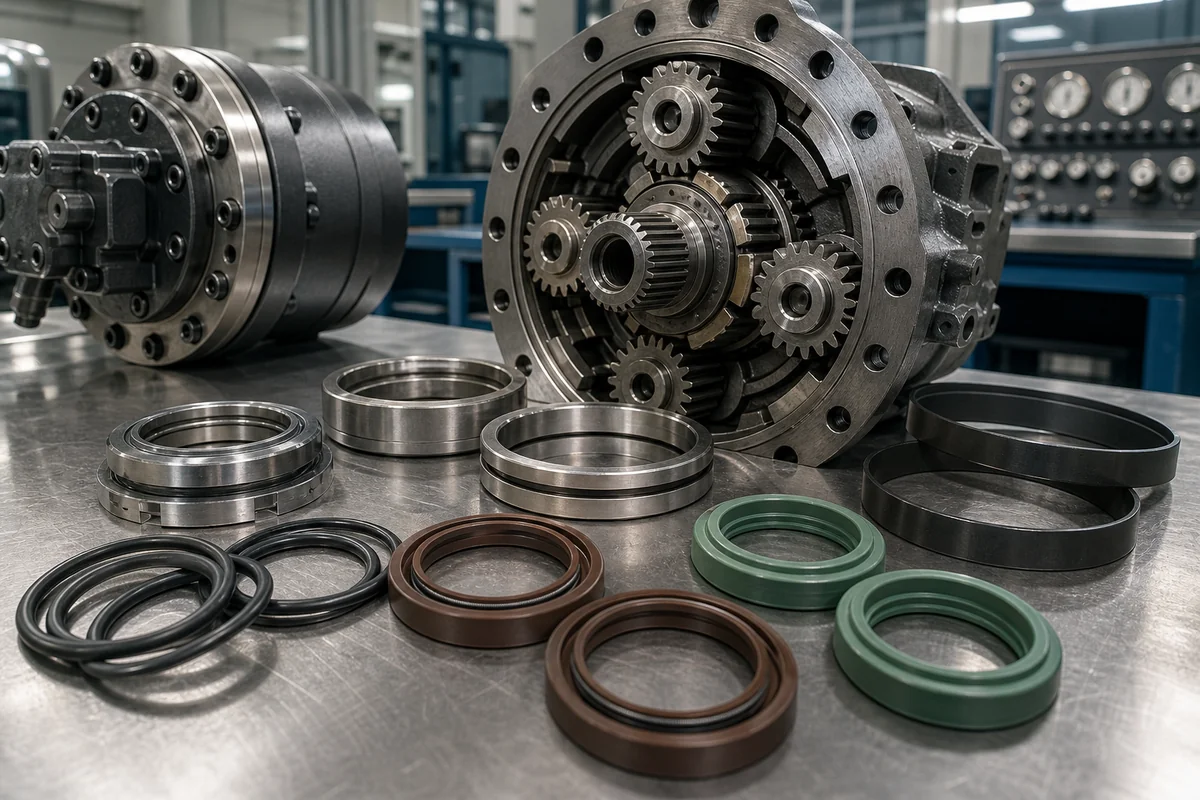
1. Excavator Travel Motor and Final Drive Architecture
A crawler excavator travel assembly is a compact, high-load planetary gearbox driven by a hydraulic axial piston motor. The motor converts hydraulic pressure into rotary motion, while the planetary reduction stages multiply torque and drive the track sprocket. The complete assembly typically integrates a hydraulic motor, multi-stage planetary carrier, sun and planet gears, floating seal (duo-cone mechanical face seal), travel brake, and final drive housing.
The floating seal is the primary barrier between the oil-filled final drive and the outside world. Unlike conventional elastomeric lip seals, a duo-cone seal uses two precision-ground metal rings, elastomer O-rings, and controlled axial pressure to maintain a reliable face-to-face seal under shock loads, side loading, and track-frame deflection.
2. Critical Seal Components in a Travel Motor Rebuild
| Component | Function | Typical Failure Mode | Recommended Material / Specification |
|---|---|---|---|
| Duo-cone floating seal | Seals final drive gear oil at the track-frame interface | Face wear, O-ring hardening, oil leakage | Hardened alloy steel rings with NBR or FKM O-rings |
| Rotary shaft oil seal | Prevents hydraulic motor oil escaping along the input shaft | Lip wear, heat cracking, extrusion | TCN / high-pressure profile, FKM or HNBR |
| Brake piston O-ring | Maintains hydraulic pressure in the travel brake circuit | Swelling, compression set, pressure bypass | High-grade NBR 90 or FKM 90 Shore A |
| Backup ring / guide ring | Prevents extrusion in high-pressure grooves | Deformation, groove damage | PTFE, PEEK, or reinforced thermoplastic |
| Static housing gasket | Seals split gearbox covers and service ports | Gasket creep, bolt relaxation | Aramid fiber, copper, or OEM molded profile |
3. Duo-Cone Floating Seal Inspection and Installation
During overhaul, every floating seal component must be inspected as a matched set. Check the metal face rings for scoring, pitting, heat discoloration, and uneven wear tracks. Even a small nick on the lapped sealing face can create a leakage path once the final drive reaches operating temperature.
- Clean the seal bores, retaining grooves, and metal face rings with a lint-free cloth and a compatible solvent.
- Inspect the O-rings for cuts, twists, flat spots, or surface contamination. Replace them whenever the floating seal is removed.
- Lubricate the O-rings and seal faces with clean final-drive gear oil; never use grease or a sharp tool that can damage the elastomer.
- Install the rings squarely and confirm that the two polished faces contact evenly around the full circumference.
- Measure installation height at several points. Uneven compression indicates a tilted ring, damaged housing, or incorrect seal-kit dimensions.
4. High-Pressure Travel Motor Shaft Seal Replacement
The motor-side rotary shaft seal operates under high peripheral speed, temperature, and case-drain pressure. A standard low-pressure oil seal is not an acceptable substitute. Rebuild specifications should identify the shaft diameter, housing bore, seal width, rotation direction, pressure rating, and elastomer compound before ordering.
For machines working in abrasive dust, deep mud, or high ambient temperatures, FKM and HNBR compounds usually provide a wider operating margin than standard NBR. A correctly specified dust lip or integrated dirt exclusion feature also protects the primary sealing lip from silica and iron-oxide particles.
5. Travel Brake Piston Seals and O-Ring Materials
Travel brakes are spring-applied and hydraulically released. Their piston seals must hold pressure without excessive friction or stick-slip. Before assembly, check piston bore finish, groove dimensions, and backup-ring orientation. A brake piston that bypasses internally can cause weak travel, delayed release, or unintended brake drag.
| Operating condition | Preferred compound | Reason |
|---|---|---|
| General excavator travel circuit | NBR 90 Shore A | Good hydraulic-oil compatibility and cost efficiency |
| High-temperature quarry operation | FKM 90 Shore A | Improved heat, oxidation, and chemical resistance |
| Low-temperature or water-contaminated service | HNBR | Balanced low-temperature flexibility and wear resistance |
6. Common Failure Modes and Root-Cause Diagnosis
Oil leakage at the sprocket or track-frame interface: usually points to a worn duo-cone floating seal, damaged O-ring, incorrect installation height, or a scored seal housing.
Hydraulic oil entering the final drive: may indicate a failed motor shaft seal, excessive case-drain pressure, blocked drain routing, or a cracked separator component.
Brake drag or weak travel: can result from swollen piston seals, bore scoring, incorrect backup-ring fitment, contaminated hydraulic oil, or a misadjusted release circuit.
Repeated seal failure after a short service interval: investigate shaft runout, bearing endplay, track-frame misalignment, overheating, lubricant contamination, and incorrect aftermarket dimensions instead of simply replacing the same seal again.
7. Seal Kit Sourcing Checklist for Rebuilders and Distributors
- Confirm excavator make, model, serial number, and travel motor / final drive manufacturer.
- Record seal dimensions and cross-reference the OEM part number before purchase.
- Specify the required elastomer: NBR, HNBR, FKM, PTFE, or another approved compound.
- Request batch traceability, material certificates, and dimensional inspection records for critical seal components.
- Use sealed, clean packaging and protect metal face seals from impact, dust, and humidity during storage.
8. DJF Seal Kits for Excavator Travel Motors and Final Drives
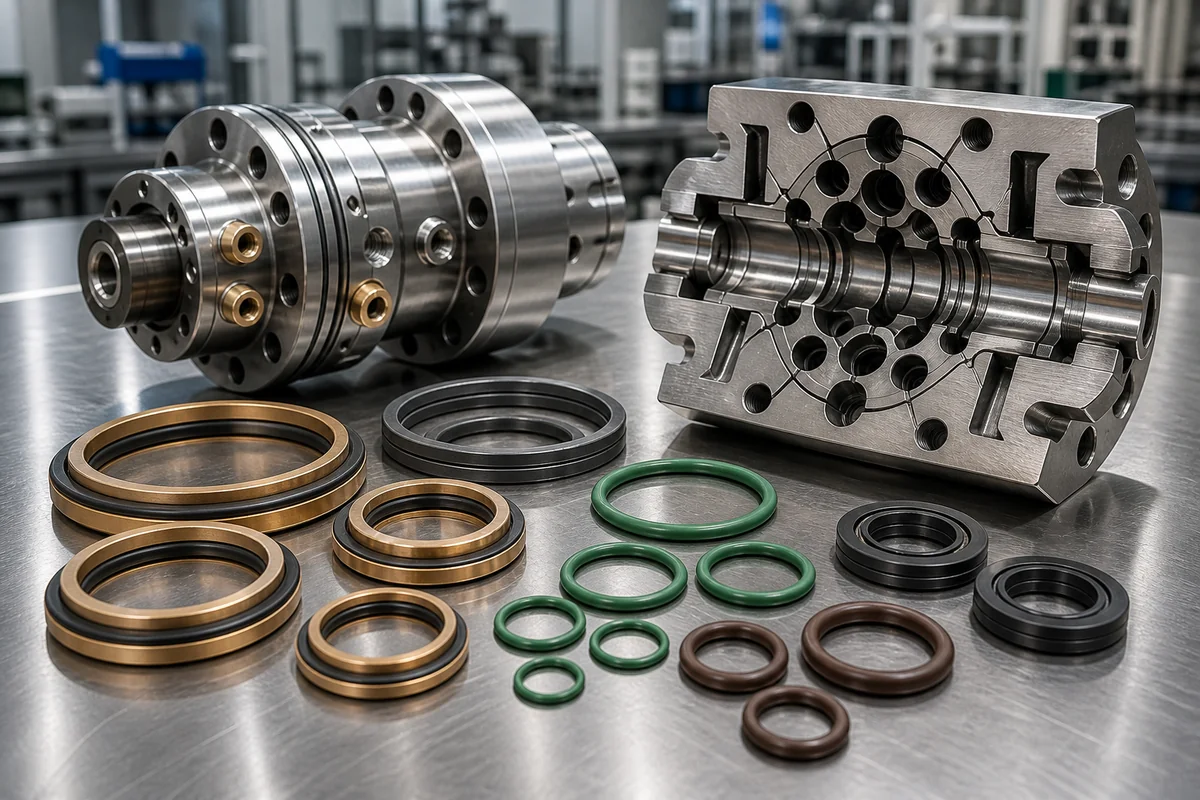
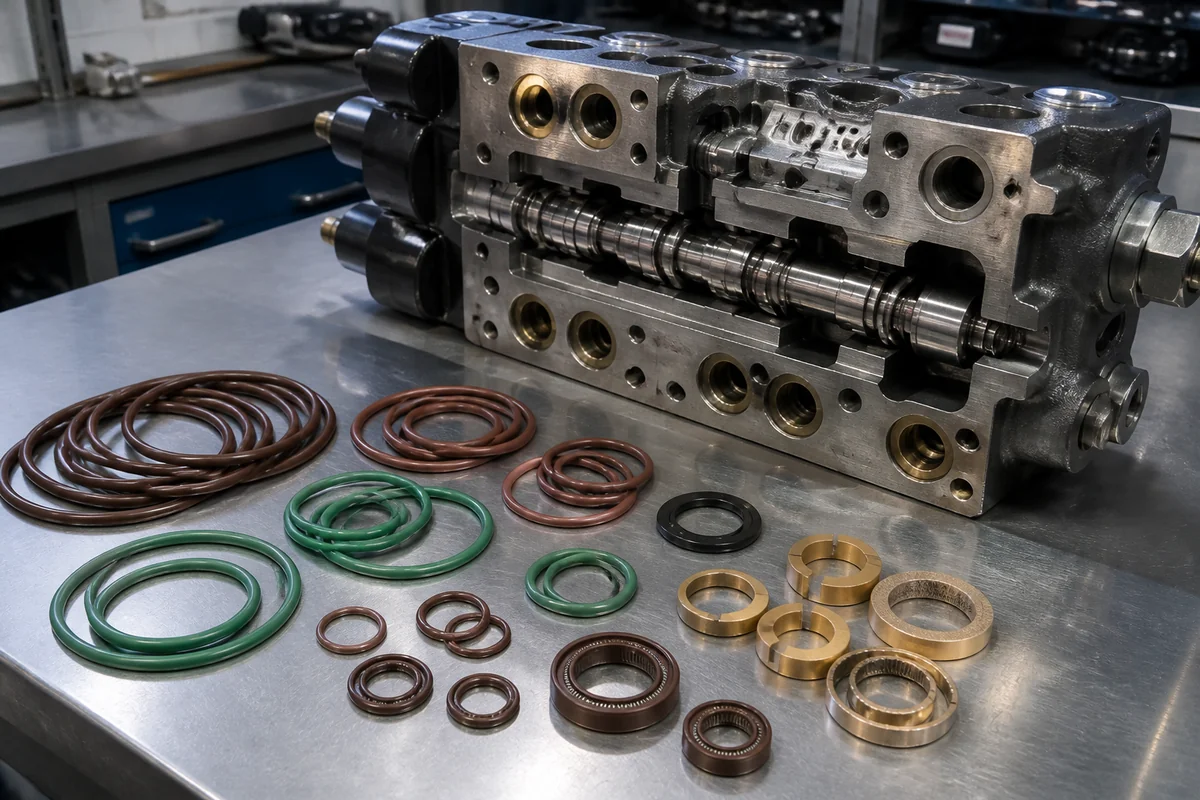
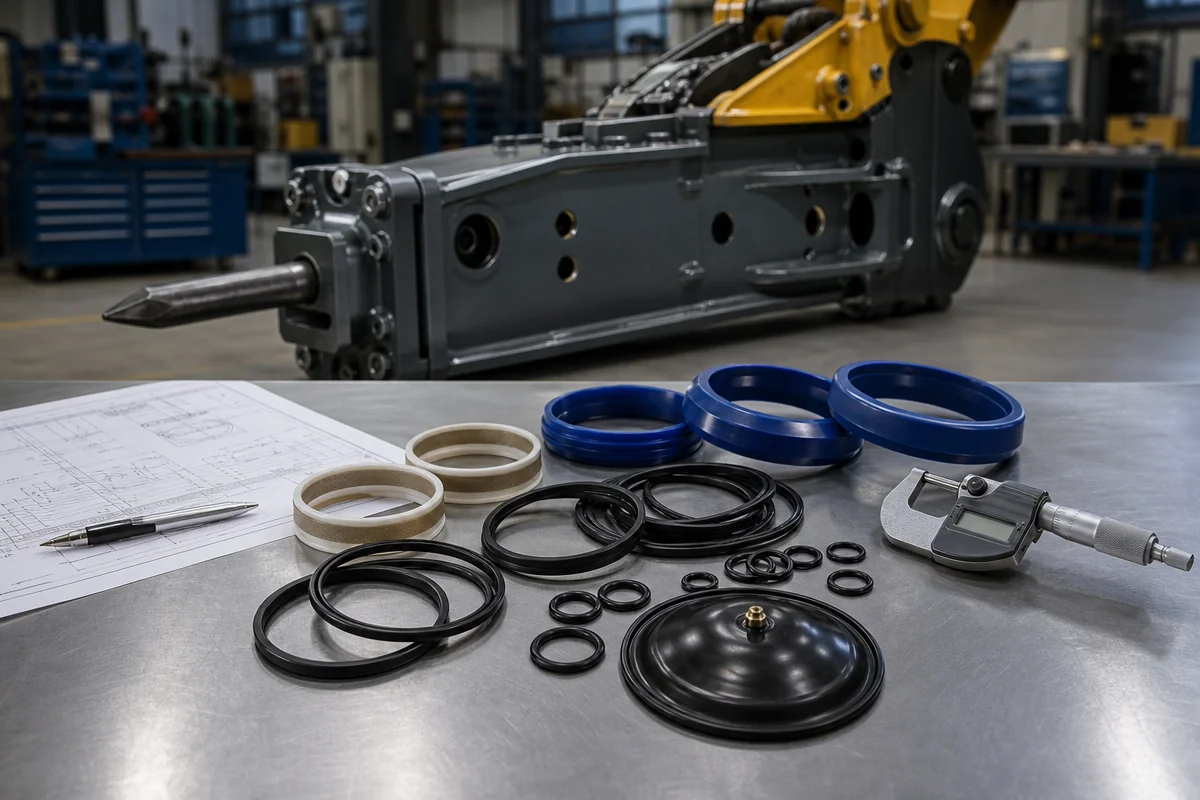
DJF supplies application-matched excavator seal kits for travel motors, final drives, swing drives, hydraulic cylinders, and related undercarriage systems. Kits can be configured with duo-cone floating seals, high-pressure rotary shaft seals, brake piston O-rings, backup rings, static gaskets, and installation accessories.
For a quotation or technical cross-reference, send the machine model, serial number, existing seal markings, and dimensions. This information allows the correct material, profile, and dimensional tolerance to be confirmed before production.
9. Final Drive Overhaul Quality-Control Checklist
| Checkpoint | Acceptance criteria |
|---|---|
| Housing and bore condition | No cracks, deep scoring, or corrosion in seal contact areas |
| Floating seal face | Clean, evenly lapped, free from chips and radial scratches |
| O-ring installation | Correct compound, no twists, cuts, pinching, or dry assembly |
| Rotary shaft seal | Correct pressure profile, shaft direction, bore fit, and lip lubrication |
| Brake piston seal | Correct groove orientation and smooth piston travel without bypass |
| Leak test | Pressure and low-speed rotation test completed with no oil seepage |
| Lubricant fill | Correct final-drive oil grade and level after initial run-in |
Conclusion
A reliable excavator travel motor and final drive rebuild depends on more than replacing visible leaking seals. The duo-cone floating seal, rotary shaft seal, brake piston O-rings, backup rings, and static gaskets must be selected as a compatible system, installed with controlled cleanliness, and validated through dimensional and leak testing. Using application-matched OEM-spec seal kits reduces contamination risk, protects the planetary gearbox, and extends uptime in demanding quarry, construction, mining, and infrastructure applications.